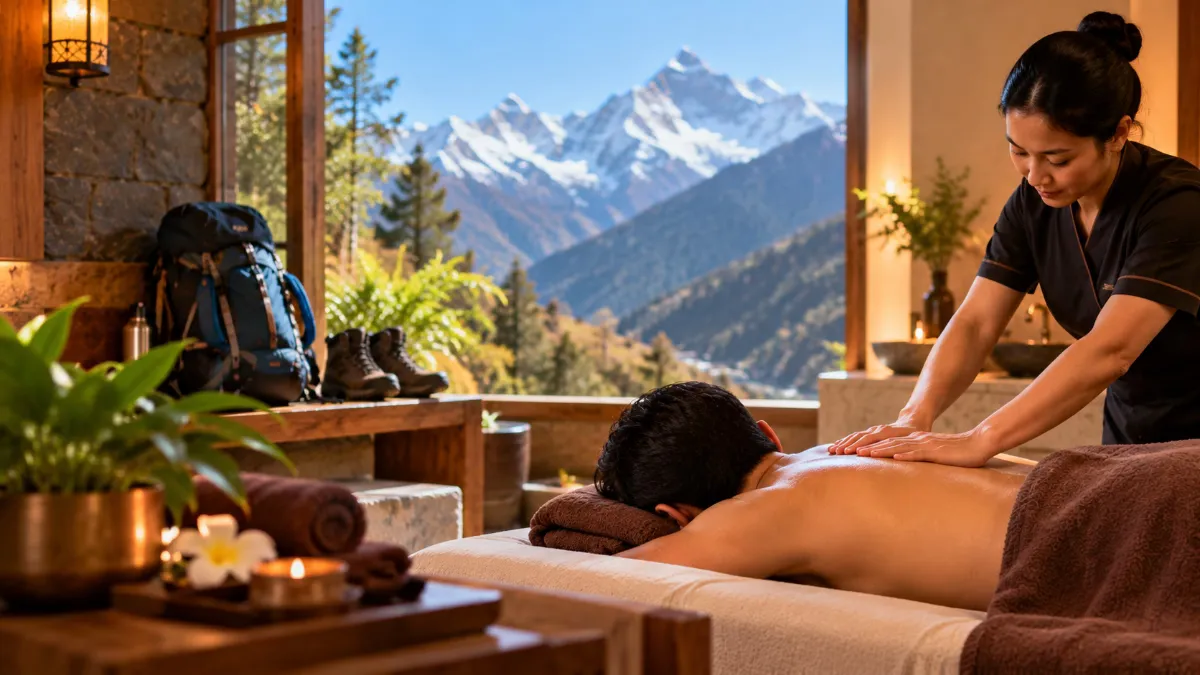
A good massage after Langtang trek starts with one number: roughly 1,400 vertical metres, the drop your quadriceps may absorb in a single day coming down from Kyanjin Gompa at 3,870m. Add several days on steep trails, with cold exposure and time above 3,500m near Kyanjin, and your legs reach Kathmandu in a very different state than they would after a hot lowland trail. Which treatment, how much pressure, and when to book all follow from that. If your legs are still very sore, start light; if the soreness has settled, you have more room to choose stronger pressure.
What Langtang Does to Your Legs Before You Book a Massage
How cold and altitude affect how your legs feel
Langtang climbs from Syabrubesi at roughly 1,470m to Kyanjin Gompa at 3,870m, about 2,400 vertical metres over around three walking days. Many itineraries allow time at Kyanjin to acclimatise before an optional push toward Tserko Ri near 4,984m. The air up there still holds about 21 percent oxygen, but lower pressure means each breath delivers less oxygen, so your body must adapt as your legs work over demanding ground. The CDC's high-altitude guidance explains that change in oxygen pressure.
Cold adds something a jungle trek never does. On exposed stretches, it can make muscles feel stiffer and less comfortable. Once you reach Kathmandu, though, it is the accumulated walking load and the soreness you still feel—not muscle that has stayed cold for days—that should guide the session. Start at a pressure your legs accept, and use warmth if it feels good rather than treating it as a prerequisite for deeper work.
The Kyanjin Gompa descent and why quads can stay sore
The hardest load on this trail is often the way down. Dropping roughly 1,400m from Kyanjin Gompa to Lama Hotel in one day forces the quadriceps into sustained eccentric work, braking every step, and that braking can produce soreness over the following one to three days. Four areas commonly complain after Langtang: the quadriceps, the calves and Achilles area, the trapezius and upper back from a loaded pack, and the lower back. Your quads may remain tender even after the other areas settle, and that shapes the pressure plan below.
Your First 24 Hours Back in Kathmandu
Rehydrate and sleep before anyone touches your legs
Drink and sleep first. Long trekking days, altitude exposure and the return journey can leave you thirsty and under-recovered, and hands-on work is unlikely to feel comfortable if you are still exhausted or dehydrated.
Avoid aggressive deep-tissue pressure while your legs are very sore, whether you reached Kathmandu today or the descent happened several days earlier. Massage may change how sore your legs feel, but it is not a shortcut to rebuilding strength. A systematic review of sports massage found small benefits for soreness and flexibility, not consistent improvements in strength or performance. You lose nothing by keeping the first session comfortable.
Where a steam bath fits before the massage
A short steam bath can be a pleasant warm-up before a post-Langtang session, but it is optional. Anura Spa's steam bath is designed for relaxation and pairs naturally with a massage. If you are new to steam, begin with five to ten minutes; regular users generally keep it around ten to fifteen minutes. Our steam-room duration guide explains how to adjust the time to your tolerance.
Skip steam if you arrive feverish, dizzy, dehydrated or unusually weak. If you have low blood pressure, heart or respiratory concerns, check with a clinician before using heat. Steam causes sweating and may leave you more lightheaded if you are already depleted from the trek; no fixed amount of water makes a session automatically safe.
Reading Your Soreness to Pick the Right Pressure
Dull ache or sharp tenderness: what each tells you
Your soreness helps you describe what feels comfortable, but it cannot diagnose an injury. Two patterns matter:
A dull, spread-out ache across the muscle belly is often ordinary delayed-onset muscle soreness. Light or moderate pressure may feel fine if the area is improving and you can relax during the treatment.
Sharp, hot or pinpoint tenderness, especially around a knee, an Achilles tendon or one spot on a quad, may signal a strain or another problem. Avoid deep pressure on that area; if symptoms are pronounced, worsening or persistent, seek medical advice rather than waiting for an arbitrary 24-hour mark.
A 60-second self-check for the four muscle groups
Before you book, walk a few steps, bend and straighten your knees comfortably, and notice the four Langtang zones in turn: the front of the thigh, the calves and ankles, the upper back beside the spine, and the low back. Do not press hard into an already painful calf or Achilles tendon to test whether it is ready. Rank the areas by soreness and tell your therapist where you want moderate pressure and where you would prefer a lighter touch.
One safety exception matters after trekking and long road travel. New one-sided calf swelling, warmth, redness or unexplained pain needs prompt medical assessment before leg massage. Sudden shortness of breath or chest pain needs emergency care. These are among the CDC's warning signs for blood clots, not symptoms to test with massage.
The Trekkers Special Massage and Why It Fits Langtang
What the 90-minute session covers
The Trekkers Special Massage is built for this exact problem. Anura Spa offers it as a 90- or 120-minute session blending deep tissue techniques, flowing Swedish strokes and assisted stretching across trek-strained areas. One booking can address legs, back and shoulders, which makes it a practical single choice for a returning trekker.
Session length changes how much time your therapist has to work around your priorities. Ninety minutes allows attention across several sore areas; 120 minutes gives more room for a fuller session. Neither length guarantees an exact number of minutes per muscle group, so tell your therapist whether your quads, calves, shoulders or feet need most of the attention.
What to tell your therapist first
Say three things at the start: you are just off Langtang, your quads absorbed a roughly 1,400m descent, and you want the session to open at lighter pressure with deeper work only where it feels comfortable. A good therapist adjusts during the session, easing off a reactive quad and spending that time on a calf or shoulder that can tolerate more.
Deep Tissue After Langtang: When It Helps, When to Wait
Signs your legs are ready for stronger pressure
Deep tissue can earn its place once your legs are ready, whether that is your first or second day back in Kathmandu or later. The practical green light is that the ache has settled to a workable dullness, there is no unexplained swelling or injury warning sign, and stronger pressure feels tolerable rather than sharp. Anura Spa's deep tissue massage targets shoulders, back and legs and opens with a short consultation using warm oil. The spa positions it for sore Himalayan legs, but the right timing depends on how you feel rather than a fixed day on the calendar.
Pairing deep tissue with foot reflexology
Your feet carried that descent too, so you might pair leg work with foot reflexology rather than a second strong leg session. Reflexology focuses on the soles, arches, heels and toes and can be a relaxing way to give tired feet separate attention without repeating deep work on the quads. For which foot treatment to prioritise and why, our guide to foot care after trekking goes deeper than there is room for here.
Lighter Options for Your First Day Back
Swedish massage when general fatigue lingers
If general fatigue is still hanging on when you reach Kathmandu, a lighter Swedish-style session may suit you better than deep leg work. Its job is relaxation: an unhurried session that may leave you calmer and more comfortable while sore areas are still reactive. Treat it as a sensible first-day option, not a weaker substitute for deep tissue. If you feel seriously unwell or have persistent altitude-related symptoms, seek medical care rather than treating them with massage.
A head, neck, and shoulder session for pack strain
A loaded pack in the cold can leave the trapezius and upper back tense, and that feeling sometimes outlasts the leg soreness. A focused head, neck, and shoulder session is a sound first-day choice when your legs are too tender for massage but your shoulders are aching. It keeps the session short and focused on the area your pack loaded for days.
A Two-Day Recovery Plan After Your Langtang Trek
With two days in Kathmandu, you can split the work along the same logic: day one for gentle relaxation, day two for stronger pressure if it feels comfortable. This is a flexible booking plan, not a recovery deadline. Many trekkers complete the hardest Kyanjin Gompa descent before their final walking day and drive to Kathmandu, so your soreness may already have changed by arrival.
Day | Session | What it covers | Booking note |
|---|---|---|---|
Day 1 | Optional short steam bath, then a lighter Swedish or Trekkers Special | Relaxation and gentle attention to legs, back and shoulders | Confirm current rates and ask for light opening pressure; steam time depends on tolerance |
Day 2 | Deep tissue if soreness has settled, plus foot reflexology if desired | Focused work on comfortable muscle areas, then soles and arches | Confirm the cost of each treatment and any available pairing |
If time or budget is limited, the single most convenient booking may be one 90-minute Trekkers Special. It folds legs, back and shoulders into a single visit rather than requiring two appointments. The two-day split makes more sense when your legs are too tender on arrival for stronger work, or when you simply prefer separate sessions. Exact Anura Spa prices and package totals should be confirmed before booking rather than inferred from general Kathmandu market ranges.
Not sure which fits your trek length and soreness level? Use the Post-Trek Recovery Tool for a personalised session recommendation before you book. Our broader massage after trekking guide compares more recovery options across Nepal's popular routes.
Planning a circuit in the other direction? Our spa before trekking guide covers how to prepare your body before the altitude load begins.
FAQs
How long after finishing the Langtang trek should I wait before getting a massage?
You can book a gentle massage when you are back in Kathmandu and feeling well enough to enjoy it. There is no universal 24-hour wait for every trekker, but avoid aggressive deep-tissue work on very sore or injured areas. Hydrate, rest and let your symptoms—not the calendar—guide the pressure.
Is the Trekkers Special better than a standard deep tissue session for Langtang recovery?
As a first session, often yes, especially when several areas feel sore. The 90-minute Trekkers Special covers legs, back and shoulders in one booking and lets your therapist begin lightly. A standalone deep tissue session concentrates firmer work on selected areas and suits trekkers whose soreness has settled enough to tolerate it.
Should I do a steam bath before my post-Langtang massage?
Only if you feel well and enjoy warmth. Start with five to ten minutes if you are new to steam; regular users generally stay around ten to fifteen minutes. Arrive hydrated, leave early if you feel lightheaded, and do not use steam as a required step before massage. Skip it when feverish or dehydrated, and check with a clinician first if you have relevant health concerns.
My quads are very sore from the Kyanjin Gompa descent; is deep pressure safe on day one?
If soreness is sharp, hot or accompanied by swelling, do not ask for deep pressure. That roughly 1,400m descent loads the quads eccentrically, but your arrival day may be several days after the descent itself. Choose a lighter Trekkers Special or another gentle option while the area remains sensitive; consider deep tissue massage only once the tenderness has settled and no injury signs are present.
How many sessions do I need to recover from a 7-day Langtang trek?
One well-chosen 90-minute session may be enough if your main goal is to feel relaxed and less sore. A second visit is an option if you want focused attention on another area, not a requirement for recovery. Massage may ease the feeling of soreness, but rest and time still do the main work of recovery.
If Langtang has left your legs, back and shoulders asking for a reset, Anura Spa in Thamel, Kathmandu offers the Trekkers Special Massage alongside lighter and more focused treatments. Share how your trek ended, where you are sore, and the pressure you prefer so the session fits the body that arrived back in Kathmandu.