Most people make the same mistake on the massage table. They either grit through pressure that is too hard, convinced that discomfort means the work is working, or they lie there in polite silence while a too-gentle session never touches the knot that sent them in. Learning the massage pressure levels, and what each one actually does to your body, fixes both problems before they cost you an hour and a booking fee.
Pressure is not a fixed personality setting or a measure of toughness. Each position on the dial does something specific to your tissue and your nervous system. The sections below map four levels to their physical effect, to the conditions they suit, and to the Anura Spa treatments built around each. You will also get the exact words to adjust pressure while you are on the table, because the right level is useless if you cannot ask for it.
What Light, Medium, and Firm Pressure Actually Do
Before you can choose a pressure, it helps to know what each one is doing under your skin. The difference is not just intensity. Which layer of tissue responds, and whether the effect lands mostly on your nerves or mostly on the muscle itself, changes with every step up the scale.
Light pressure: calms the nervous system, not just the muscles
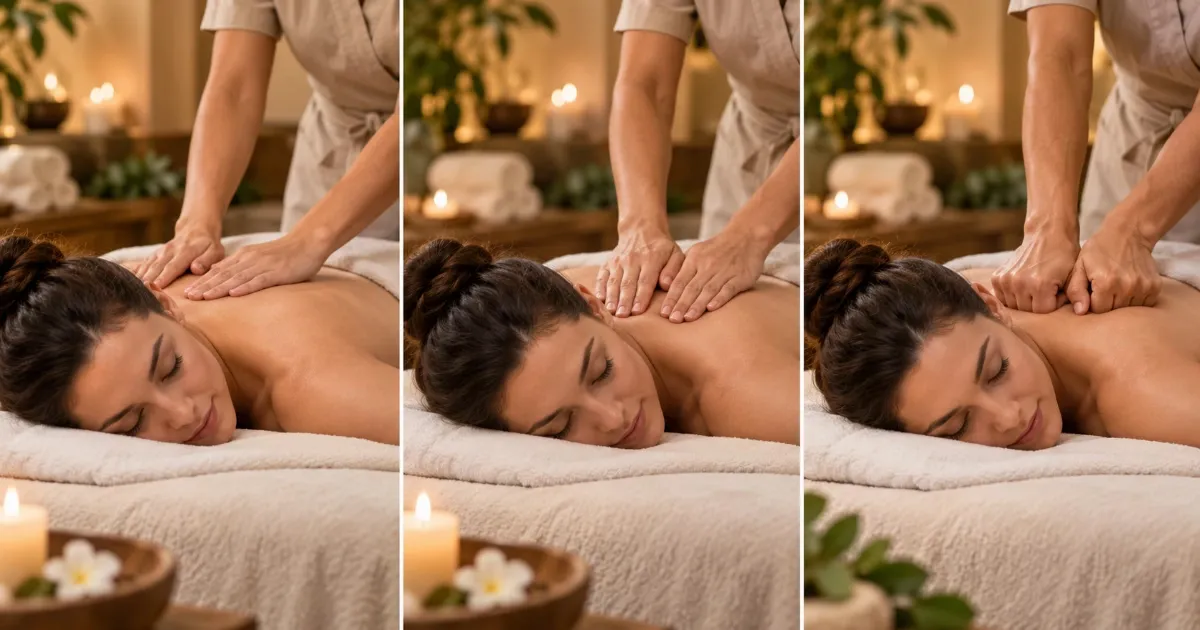
Light pressure barely compresses the muscle. Almost all of its effect happens at the skin, where a slow, gliding touch stimulates the pressure receptors sitting just below the surface. That signal nudges your body toward a parasympathetic state, the calming branch of the nervous system that slows your heart rate and unwinds the fight-or-flight tension you walked in with. A 2010 review by the Touch Research Institute at the University of Miami found that moderate, steady pressure raised vagal activity and slowed heart rate in a way the lightest brushing touch did not. Gentle work soothes the mind, but it needs a little weight behind it to move the body.
Medium pressure: the working depth that covers most conditions
Medium pressure sinks past the skin into the belly of the muscle, enough to knead out everyday tension without triggering the guarding reflex that heavier work provokes. The research backs it as the sweet spot. A 2013 study published in Complementary Therapies in Clinical Practice, examining adults with rheumatoid arthritis, found that moderate-pressure massage produced less pain, stronger grip, and better range of motion than light pressure alone. For the vast majority of clients, medium is the target, not a compromise between gentle and deep.
Firm pressure: reaches fascia and chronic adhesions
Firm pressure works mechanically. Sustained, deliberate force presses into the deeper muscle layers and the fascia around them, physically disrupting the collagen cross-links that build up in adhesions, those stubborn, ropey spots you can feel under a thumb. Local circulation rises sharply in the area, and that blood flow is part of how tissue recovers. MASSAGE Magazine notes that therapists generally keep intensity at or below 7 on a 1-to-10 scale; above that, there is a real risk of damaging tissue rather than releasing it.
Massage Pressure Levels Chart: Four Points, One Reference
Almost every guide online splits pressure into three tiers. Anura Spa's therapists use four, because collapsing "gentle" into "light" hides a genuinely different kind of work, and lumping "firm" with "deep" erases the distinction that trips up most first-time bookers.
| Pressure level | Tissue depth reached | Typical sensation | Best suited to |
|---|---|---|---|
| Gentle | Skin and surface fascia only | A light, soothing glide with almost no compression | Sensitive skin, lymphatic support, deep relaxation |
| Light/Medium | Superficial muscle into the muscle belly | Steady and present, a comfortable "leaning in" with no sharp edges | Everyday tension, stress relief, general relaxation, most first sessions |
| Firm | Deeper muscle layers and fascia | Strong and clearly felt, the "hurts so good" range, never electric | Chronic tight spots, post-trek leg fatigue, dense muscle |
| Deep | A specific muscle group, worked layer by layer | Intense in isolated spots, slow and deliberate | Long-standing adhesions, specific chronic knots, restricted range of motion |
Which Anura Spa modalities default to each pressure
A treatment's name already hints at its default pressure, though a good therapist adjusts within that range. At Anura Spa, the menu lines up like this:
- Swedish massage: light to medium, built on long gliding strokes and gentle kneading
- Thai Stretching: medium to firm, combining assisted stretches with rhythmic compression
- Deep Tissue: firm to deep, slow and targeted
- Acupressure Shiatsu: firm, applied in concentrated points
- Foot Reflexology: medium to firm, concentrated on the feet and soles
One misconception is worth clearing up before you book. Deep tissue describes a method, working sequentially from the surface layers down to a specific target muscle. A skilled therapist varies depth zone by zone even within one deep tissue session, and the experience is intense in the tightest spots but should never actually be painful. Firm pressure, by contrast, is simply an intensity setting that can be dialed into almost any treatment. If you want the fuller comparison, our guide to Swedish versus deep tissue covers where each one wins, and what deep tissue treatment actually involves goes deeper still.
Light Pressure Massage: Best for Relaxation and First Timers
For a first session, or any booking driven mainly by stress and a need to switch off, start at light to medium. Gentle work will not release a deep chronic knot, and it is honest to say so, but that is not its job. Its job is to down-shift your nervous system, and it does that better than heavier pressure, which can keep an anxious first-timer braced and tense for the full hour. A Swedish massage sits right here for a reason. The long, unhurried strokes are designed to relax rather than dig. Sensitive skin, pregnancy, and a genuine need for calm all point the same direction, and there is no upsell hiding in the recommendation.
Medium Pressure Massage: The Best Default for Most Clients
Here is the recommendation almost no franchise page commits to plainly: if you are unsure, ask for medium. Medium reaches real muscle, so it addresses the everyday knots and tension that bring most people in, but it stops short of the depth that leaves you sore the next morning. It also gives your therapist room to move, leaning into a tight spot and backing off a tender one without changing the whole approach. Think of medium as the standard lens on a camera: not the widest, not the longest, but the one that handles most of what you will ever shoot. For a first-timer who wants results and not just relaxation, medium at light-to-medium intensity is the smart default.
Firm Massage Pressure: When Deeper Work Actually Helps
Firm pressure earns its place with a specific set of problems: dense muscle, chronic tightness, and the deep fatigue that follows hard physical effort. Two situations show exactly when to reach for it, and when to hold back.
Post-trek muscle recovery and firm-pressure timing
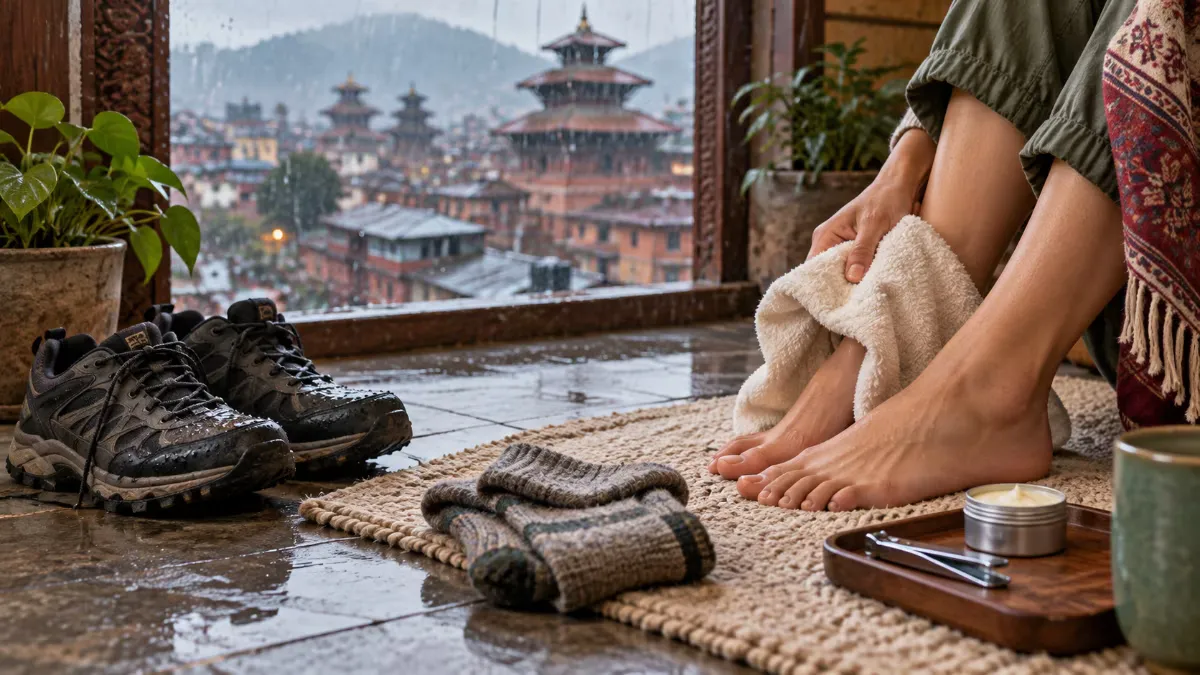
Come off a multi-day route in the Himalaya, and your legs take the worst of it. Anura Spa's own post-trek recovery guide identifies the calves, thighs, feet and soles, hip flexors, and lower back as the zones that load up on a long descent, along with the shoulders from carrying a pack. That distribution matters for pressure. Quads, calves, and glutes have done thousands of loaded contractions and respond well to medium-to-firm work; your upper back, sore mostly from pack straps, rarely needs the same depth. Booking a full-body deep tissue session and having the therapist apply equal intensity to your shoulders as your legs is the common error. One further caution: research on post-exercise massage, including a review in the Journal of Athletic Training, confirms it reduces delayed-onset muscle soreness, but does not reliably restore strength or performance. Treat it as recovery support, not a shortcut back to full power.
Chronic tension versus acute soreness: different treatments
Chronic tension and fresh soreness call for different hands. A chronic back knot is an adhesion built up over months of desk posture or repeated strain, and it responds to sustained, firm, deep work that slowly breaks it down. Acute soreness is different: the dull ache 24 to 72 hours after a hard trek or a new workout is an inflammatory response in tissue that is already irritated. Applying firm deep-tissue pressure to freshly inflamed muscle often makes it worse. The better play is medium pressure first, graduating to firm once the acute phase settles. There is also a timing rule inside a single session: tissue tolerates more as it warms, so effective deep work belongs in the second half, roughly 20 minutes in, not from the first stroke.
Which Pressure and Treatment Fits Your Condition
Pressure should track the condition you are treating, not your pain tolerance or the most impressive name on the menu. What follows is Anura Spa's guided-practice mapping, drawn from how our therapists match a presenting complaint to a pressure level and a treatment. Use it as a starting point for the conversation, not a clinical diagnosis.
- Post-trek soreness in the legs: medium easing into firm, best served by Deep Tissue on the quads and calves, or Thai Stretching to lengthen tight hip flexors.
- Stress headache and tight neck: light to medium, a Swedish massage focused on the neck and shoulders, or Foot Reflexology if you would rather not have hands near your head.
- Chronic back knot: firm to deep, Deep Tissue on the specific muscle group, worked over one or two sessions.
- General relaxation: gentle to light, a full Swedish massage with no agenda beyond switching off.
- First session, unsure what you need: light to medium, Swedish, so you can learn what your body responds to before committing to deeper work.
How to Ask Your Therapist to Adjust Pressure Mid-Session
The right pressure means nothing if it stays in your head. Therapists genuinely want feedback, because they cannot feel your tissue from the inside, and a mid-session adjustment is routine. The trick is being specific about where and how much.
Two phrases that get results without awkwardness
Two sentences do almost all the work. To dial it down: "Can you ease up on my left shoulder?" To dial it up: "A little more pressure on my lower back would really help." Both name a body zone and a direction, which is exactly what your therapist needs. Vague feedback like "that's fine" or a tense silence leaves them guessing. Your body will also signal when the pressure has crossed the line before your mouth does: you catch yourself holding your breath, your muscles brace against the stroke instead of softening, or you feel something sharp or electric rather than a deep ache. Any of those three is your cue to speak up.
What changes in technique when you ask for less pressure
Asking for a lighter touch triggers a shift in approach, not just a reduction in force. A good therapist tends to switch to broader, slower strokes, using the flat of the palm or forearm instead of a thumb or elbow, and often works the tissue around a tender spot before returning to it. Easing off does not mean the area gets ignored. The same knot gets approached from a gentler angle, which is frequently what lets it release in the first place.
Common Questions About Massage Pressure Levels
What pressure level should a first-time massage client request?
Light to medium, specifically a Swedish massage at that range. It reaches real muscle and delivers noticeable relief without the next-day soreness that heavier work can leave. Start there, and ask for more once you know how your body responds.
Is deep tissue massage always the firmest pressure option?
No. Deep tissue describes a method: working layer by layer into one specific muscle group, with depth varying across your body throughout the session. Firm pressure, by contrast, is simply an intensity level that can be applied within many treatments, including Swedish.
Can firm massage pressure cause soreness or bruising the next day?
Mild soreness for 24 to 48 hours is common after your first few firm or deep sessions, similar to the ache after a new workout, and it fades on its own. Bruising is not expected. If you bruise, or feel sharp pain during the session, the pressure was too high, and that is worth flagging immediately or before your next visit.
How do I tell my therapist mid-session that the pressure is too hard?
Say it plainly and name the spot: "Can you ease up on my left shoulder?" works perfectly. Therapists expect and welcome this. No apology is needed, and there is no reason to wait until the end, since adjusting pressure mid-session is a normal part of the work.
Which pressure level works best for muscle soreness after trekking?
Medium-to-firm, concentrated on the legs. Quads, calves, and glutes take the brunt of a long trek and respond well to that range. Save the deepest work for genuinely chronic tightness, and in the first day or two after a hard route, start at medium before graduating to firm once the acute soreness settles.
Should the same pressure level be used across your whole body?
No, and a skilled therapist will not. Pressure should shift with the tissue: firmer on dense areas like the glutes and upper traps, lighter over bony or sensitive spots. Varying it zone by zone within one session is a sign of good technique.
For most first-time clients, medium pressure is the right starting point: real muscle engagement without the risk of next-day soreness. Firm pressure belongs with specific chronic knots and post-trek recovery work, not as a default. Not sure which level suits your body right now? Take the 2-minute massage quiz for a personalised recommendation from Anura Spa, then walk in already knowing what to ask for.