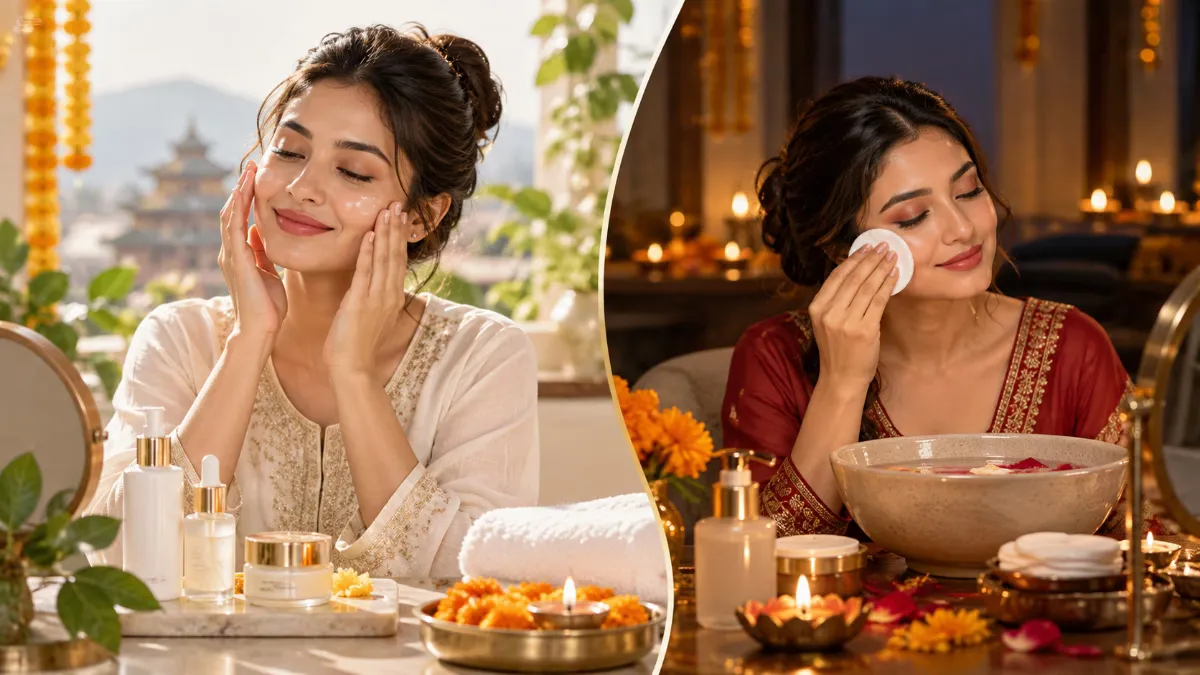

You will stand at the ghat for two to three hours, facing open water with little shade, while you offer arghya to the setting and then the rising sun. Very few festival routines put your bare face and hands under open sky for that long, that close to reflective water. The ritual is fixed and sacred; your skincare simply works around it. Chhath Puja skincare is really about timing: the right step on the right day. This is a day-by-day plan keyed to the four stages of the festival, so each step lands when it actually matters.
Chhath Puja 2026 in Nepal runs from November 13 to 16: Nahay Khay on Friday, November 13; Kharna on Saturday, November 14; Sandhya Arghya on Sunday, November 15; and Usha Arghya on Monday, November 16. According to Kathmandu sunrise and sunset data, sunset on November 15 is approximately 5:11 PM, while sunrise on November 16 is around 6:25 AM. These are solar times, not officially prescribed arghya times, so confirm the ritual schedule against your local Nepali panchang or ghat organisers before the festival begins.
What Chhath Puja does to your skin across four days
Each of the four days stresses your skin differently, which is exactly why a single “wear sunscreen” tip misses most of the problem.
Two to three hours of open sun at the arghya
The offering itself is brief. The vigil around it is not. Devotees may reach the ghat well before sunset, often from around 3 PM for the evening arghya, and hold position near the water with limited shade. That cumulative exposure, not only the moment of offering, can contribute to tanning and pigmentation.
River and pond water at the ghat and your skin barrier
Standing in river or pond water can leave the skin feeling tight, particularly after prolonged wetting and drying. Silt or other irritants in natural water may also bother sensitive skin. Rinse with clean water when you can, pat dry gently, and avoid rubbing or scrubbing already irritated areas.
What the Kharna fast may mean for skin by Day 3
The nirjala vrat observed by many devotees begins after Kharna and continues until Usha Arghya, often lasting roughly 36 hours without water. A 2019 review in Nutrients describes possible effects of fasting on skin-barrier function, but the relevant evidence is limited and much of it comes from animal research. It does not establish that the same barrier changes occur during a Chhath fast. If your skin feels dull, tight, or reactive, read that as a reason to keep your skincare gentle, not to pile on active ingredients.
Days 1 and 2: prep during Nahay Khay and Kharna
Everything you do in the first 48 hours is about starting the arghya with a calm, comfortable skin barrier.
A minimal cleanse-and-moisturise routine around ritual prep
After the Nahay Khay bath, rinse away any residual river or pond water at home and use a gentle cream or milk cleanser rather than a harsh, stripping face wash, then seal with a plain, fragrance-free moisturiser. That is the whole routine. If you prefer a professional cleansing session before the festival, AnuraSpa’s cleansing therapy is an option; avoid scheduling an unfamiliar or intensive treatment just before the arghya.
Stay normally hydrated on Nahay Khay and during Kharna while drinking is permitted, because after the nirjala fast begins you cannot replace fluids until the fast ends. If you have a medical condition that makes prolonged fasting without water risky, seek personalised medical guidance.
What to skip in the 48 hours before the arghya
Pause potentially irritating new or strong products now: no new retinol, strong exfoliating acids, abrasive scrubs, or unfamiliar formulas. A skin barrier that already feels sensitive is not the place to test anything. Keep the routine deliberately boring, so your skin reaches Day 3 as comfortable as possible. One useful resource in the lead-up: our Dashain beauty preparation guide and Tihar nail and hand care guide both follow the same principle of planning treatments ahead of busy festival days.
Sun protection for the evening Sandhya Arghya on Day 3
The afternoon before Sandhya Arghya is where your skin may receive the most meaningful sun exposure, not the brief moment of sunset. Kathmandu’s November sun sits lower than it does in summer, but UV radiation still matters during a long outdoor vigil. UV is generally strongest closer to midday and weakens as sunset approaches; reflected light from water can add to exposure. For this reason, focus on protection while you are arriving and waiting at the ghat, not only during the offering itself.
Which SPF to use, and when to apply it before sunset
Use a broad-spectrum SPF 50 sunscreen, ideally with PA++++ protection where that rating is available. SPF 30 is an acceptable minimum, but SPF 50 is a reasonable choice for a long outdoor gathering. The PA rating indicates tested UVA protection; it does not replace SPF, which indicates protection against sunburn-causing UVB. Choose a water-resistant formula, apply it generously to clean, dry skin before you leave home, and allow around 15 minutes before sun exposure. The American Academy of Dermatology’s sunscreen label guide explains what broad-spectrum and water-resistant labels mean.
Where practical, add sun-protective clothing, a hat, shade while waiting, and UV-protective sunglasses. Sunscreen works best as part of a broader sun-protection routine.
Reapplying after you step out of the ghat water
Water-resistant sunscreen is labelled for either 40 or 80 minutes in water, not for unlimited immersion. Towel-drying can remove the protective film regardless of how much time remains on the clock. Carry your sunscreen to the ghat and reapply after leaving the water and drying off; reapply approximately every two hours when outdoors, or sooner as the product label directs after water exposure or heavy sweating.
Morning Usha Arghya on Day 4: lower UV, not zero UV
The sunrise vigil is usually the gentler of the two for UV exposure, but sun protection still matters if you remain outdoors after daybreak.
Apply SPF at home if you will be outdoors after sunrise
You may leave for the ghat while it is still dark. If you expect to remain outside after sunrise, apply the same broad-spectrum, water-resistant sunscreen at home before leaving rather than trying to manage your routine in a crowded space. UV exposure is very low at the horizon and increases as the sun rises, so focus on the length of your outdoor stay as well as the offering itself.
Protecting lips and the eye area at the sunrise vigil
Lips and the delicate skin around the eyes are easy to overlook. Use an SPF lip balm and apply a suitable sunscreen carefully around the orbital area without getting it into your eyes. UV-protective sunglasses help cover what skincare alone cannot. Cool dawn air can also leave lips feeling dry, so a simple balm earns its place twice over.
Post-Chhath Puja skincare: recovery from Day 4 onward
Your post-Chhath Puja skincare routine begins after the morning arghya and the fast have ended. The first rule is to do less than you want to.
When to resume exfoliating after sun exposure
Give sun-exposed skin a few days of gentle care before considering exfoliation, and wait longer if it feels hot, sore, red, or irritated. A fixed three-day deadline cannot tell you whether the barrier has recovered. The American Academy of Dermatology advises never exfoliating sunburned skin. Start with fluids after the fast, as appropriate for you, then a plain moisturiser morning and night. If you enjoy a hydrating sheet mask, choose one you already know your skin tolerates. Let the skin settle before you ask anything more of it.
How to care for tanned skin in the weeks after Chhath
A Chhath tan can fade gradually, but the timeline varies widely: deeper pigmentation may last several weeks or longer. Keep wearing SPF while the tan fades, because further UV exposure can darken it again. Once the skin feels normal, a well-tolerated vitamin C serum may be useful for uneven tone, and gentle exfoliation can help with surface dullness if your skin tolerates it. Neither step guarantees complete tan removal within 10 to 14 days. Avoid aggressive treatments or introducing several new active ingredients at once.
When to book a professional facial or body scrub
Home care comes first, always. If dullness or rough texture is still there after a couple of weeks and your skin has settled, that is the point to consider a professional treatment, not before. A gentle facial or a body scrub, if appropriate for your skin, can support hydration and smoother-feeling skin; neither should be expected to erase deeper pigmentation. For the wider seasonal picture, the Kathmandu seasonal skincare guide covers how the same skin shifts from monsoon into the dry festival months.
Six mistakes that make Chhath sun damage worse
Most Chhath Puja skincare mistakes are timing errors, not product errors.
Waiting until you reach the ghat to apply sunscreen instead of covering exposed skin before you head into the afternoon sun.
Using a formula that is not water-resistant, then assuming it will last through prolonged immersion.
Exfoliating sunburned or irritated skin shortly after the arghya instead of waiting until it has recovered.
Applying unfamiliar fragranced or strongly active products to skin that already feels reactive or lightly burned, rather than keeping the routine gentle.
Skipping the lips and eye area entirely, even though these spots also need appropriate protection.
Focusing only on the SPF number while forgetting reapplication, water-resistance labels, clothing, shade, and sunglasses.
Chhath Puja skincare: your questions answered
Can I apply sunscreen during Chhath Puja without breaking ritual purity rules?
Sunscreen is a topical product rather than food or drink, but customs about what products are appropriate during Chhath can differ between families and communities. Follow your family’s practice or ask a knowledgeable ritual guide if you are uncertain. If you use sunscreen, a plain, fragrance-free formula may fit more comfortably into your preparation.
How long does a Chhath Puja tan take to fade completely?
There is no fixed 10-to-14-day answer. Mild tanning may gradually fade as your skin renews, while deeper pigmentation can remain for weeks or longer. Daily sun protection is the foundation; a gentle, well-tolerated brightening routine may help over time. Avoid aggressive exfoliation while the skin is still irritated.
Is it safe to exfoliate my skin the day after the arghya?
If your skin is sunburned, sore, or irritated, no. Give it time to recover, moisturise gently, and only resume exfoliation when the skin feels normal again. The right interval varies by person and by the amount of sun exposure.
Should I change my moisturiser during the Kharna fast?
Only if your skin feels tight. A plain, fragrance-free moisturiser may help with comfort during the fast. Avoid introducing a new active product when your skin is already feeling sensitive; keep it simple and barrier-supportive.
What SPF rating holds up when I am standing in river water for the arghya?
Choose a broad-spectrum SPF 50 sunscreen, ideally PA++++, labelled water-resistant for 40 or 80 minutes. No sunscreen is waterproof. Reapply according to the label, particularly after towelling off, leaving the water, or sweating heavily, as well as approximately every two hours while outdoors.
If your skin still feels sun-stressed once the festival is over, consider AnuraSpa’s facial treatments or body scrub treatments after any irritation has fully settled. For painful sunburn, blistering, or persistent pigmentation, seek advice from a qualified healthcare professional.