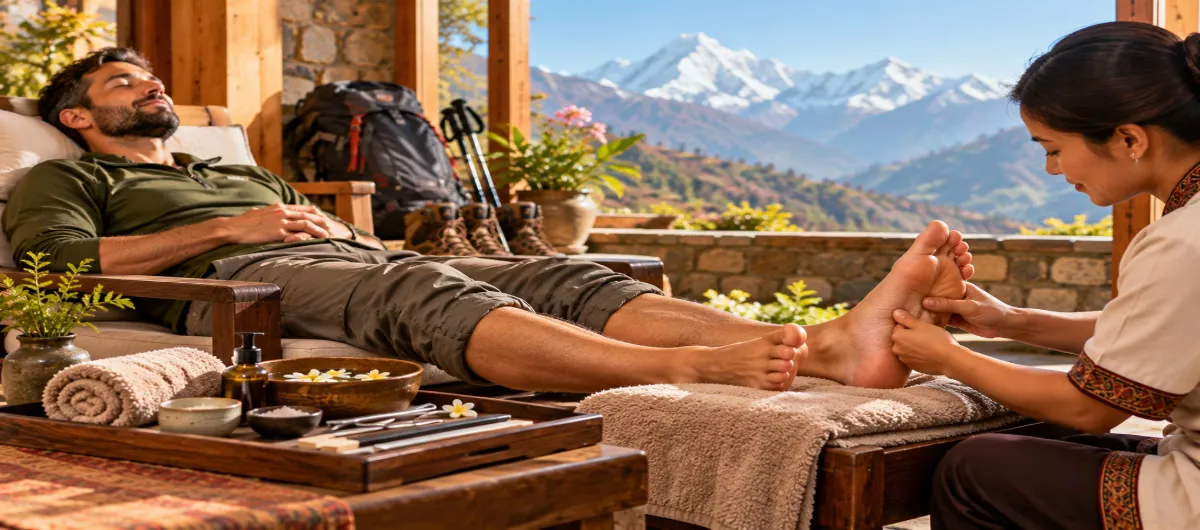
You are back in Thamel with a flight in three days and feet that took a beating on the descent. The question now is what to book first. Good foot care after trekking is a sequencing problem, not a menu choice, and getting the order wrong wastes both money and healing time.
Most returning trekkers may benefit from some combination of the usual options: a pedicure, a reflexology session, and genuine rest. Booked at the wrong time, though, a pedicure on open blisters or reflexology while a foot is significantly swollen can be the wrong choice. This guide matches your specific symptoms to the right treatment order, starting with the safety signs that decide whether either treatment belongs on the schedule yet.
What a Multi-Day Trek Does to Your Feet Before Any Treatment
Skin, nails, muscles, circulation: four kinds of damage
Everest Base Camp, the Annapurna Circuit, and the Langtang Valley return all punish feet in four distinct ways, and each one responds to a different kind of care.
Skin takes the first hit: blisters from repetitive friction, cracked heels from dry high-altitude air, and calluses built up over days of loaded walking. Nails come next. Steep descents, the EBC drop from Namche especially, drive your toes into the boot's front wall thousands of times, and the result can be a subungual hematoma, the bruised black toenail.
Below the surface, muscle and connective tissue can feel shortened and tight, with the arch and calf carrying much of the strain. Last is swelling. Hours of standing and downhill loading can leave many trekkers with puffy feet or ankles after a long day.
Why symptoms matter more than a fixed 24 to 48 hour rule
You do not automatically need to wait 24 to 48 hours after every trek before booking foot care. The timing depends on what your feet look and feel like. If there is significant swelling, a suspected soft-tissue injury, or pain that makes normal walking difficult, a short period of protection and elevation may be appropriate before hands-on treatment.
The PEACE and LOVE framework was developed for soft-tissue injuries and recommends brief protection after injury, followed by gradual return to comfortable movement rather than prolonged rest. For a trekker without active swelling, open skin, or suspected injury, there is no universal rule requiring a two-day wait. Any useful answer starts with what symptoms are present, not simply how many hours have passed.
Sequencing Your Foot Care After Trekking: Read the Feet First
Before you book anything, spend two minutes reading your own feet in the hotel room. The assessment runs as a short decision flow, and safety questions come before comfort or preference.
A four-question self-check before you book anything
Are your ankles still visibly swollen or puffy? If the swelling looks mild and linked to a long day on your feet, pause hands-on foot treatment and use rest, elevation, and gentle comfortable movement first.
Do you have open blisters or broken skin anywhere on the foot? That rules out pressure over the affected area and a standard pedicure until the skin has fully closed.
Skin and nail damage but no open wounds, significant swelling, or severe pain? A pedicure can be your first booking.
Deep fatigue and a tight, aching arch with intact skin and no significant swelling? Reflexology can be a reasonable comfort-focused option.
The order is deliberate. Safety questions come before comfort questions, which is why swelling and broken skin sit at the top.
Get medical advice instead of booking spa treatment if: swelling is mainly in one leg, the area is unusually warm or red, pain is severe or worsening, you cannot bear weight normally, swelling appeared suddenly without a clear reason, or you have chest pain or sudden shortness of breath. One-sided leg swelling can be a sign of deep vein thrombosis, which needs prompt medical assessment.
Pedicure After Trekking: Skin, Nails, and the Right Timing
What a post-trek pedicure does that a salon pedicure skips
A holiday pedicure is usually cosmetic. A post-trek pedicure should start with a careful condition check, with polish optional. The therapist should assess blisters before any soak or exfoliation, because broken skin should not be treated like ordinary dry skin.
Callused areas may need more attention than they would after everyday walking, but the work should still stay comfortable rather than aggressive. Nail care also changes for a bruised toenail: instead of cutting deeply or forcing back a lifting nail, the approach should be conservative and allow the damaged nail to grow out.
When a pedicure is your right first booking
Book the pedicure first when the main problem sits on the outside and the skin is intact: cracked heels without deep open fissures, heavy calluses across the ball of the foot, dry flaking along the arch, and nails that need tidying but are not severely painful or unstable.
If a blister has already dried and fully closed, a pedicure can work around the healed area gently. Open blisters change the answer, so wait until the skin has completely closed and is no longer draining or tender. Healing time varies; the NHS notes that many blisters heal on their own within about a week.
Foot Reflexology After Trekking: Tired Arches and Deep Fatigue
The arch and heel areas a long descent overloads
Reflexology gives focused attention to areas a descent can leave tired, including the arch, heel, toes, and ankle region. Traditional reflexology maps areas of the foot to different parts of the body, although those proposed connections have not been scientifically established.
The U.S. National Center for Complementary and Integrative Health describes reflexology as pressure applied to specific points on the feet or hands and notes that claims that those points produce healing elsewhere in the body have not been proven.
For a returning trekker, the practical reason to choose the session is simpler: comfortable, foot-focused pressure on tired feet once the skin is intact and significant swelling has settled.
When reflexology becomes a reasonable option
Reflexology can move to the front once significant swelling has gone down, the skin is intact, and there is no suspected injury that needs assessment. There is no fixed 'day two' or 'day three' threshold for every trekker; symptoms matter more than the calendar. Once those safety concerns are clear, a gentle foot-focused session may help the feet feel less sore and tense after repeated days of walking.
Research on massage after strenuous exercise supports modest improvements in soreness, but it does not show that massage reliably 'flushes' fatigue or restores performance. If you want broader muscle work as well, deep tissue massage may be considered separately once there is no active injury or significant swelling. A typical trekker foot session may run 45 to 60 minutes, depending on the service booked.
Rest and Elevation: What They Fix and Where They Stop
What a short period off your feet can resolve
Rest is the most underrated of the three when your feet are actively irritated, swollen, or dealing with broken skin. A period off your feet with comfortable elevation can help mild dependent swelling settle and gives irritated skin time to recover.
If you have an actual soft-tissue injury, brief protection may also be appropriate. But prolonged complete rest is not automatically better; as symptoms allow, gentle movement is usually preferable to staying completely inactive for days.
Two things rest cannot do
Rest can settle irritation, but stiffness and post-exercise soreness do not always disappear immediately. It also does not mean every tired foot needs to stay untouched for a fixed number of days.
Once there is no suspected injury, significant swelling, or open skin, some trekkers prefer gentle foot pressure or massage simply because it feels more comfortable than continuing complete rest. Rest sets the stage when symptoms call for it; it is not a universal waiting period for every returning trekker.
Pedicure vs Reflexology vs Rest: A Side-by-Side Look
Anura Spa's therapists work with returning trekkers year-round, and the table below uses the same symptom-first logic: identify the main problem, choose the safest first step, and watch for the signs that should send you to medical care rather than a spa treatment.
Symptom | Book first | When to consider it | Watch for |
|---|---|---|---|
Active ankle swelling | Rest/elevation if mild and clearly linked to time on your feet | Reassess as swelling settles | One-sided, hot/red, severe, sudden, or unexplained swelling: seek medical care |
Open blisters or broken skin | Protect the area; defer work over broken skin | After the skin has fully closed and is no longer draining or tender | Increasing redness, warmth, pus, fever, or worsening pain |
Black or bruised toenail | Gentle nail care only if stable and not severely painful | Once swelling and skin problems have settled | Intense/worsening pain, deep cut, major trauma, or suspected fracture: medical assessment first |
Heavy calluses or cracked heels | Pedicure | When skin is intact and there is no hidden blister or painful open fissure | Avoid aggressive cutting or treatment over broken skin |
Tight arch, tired feet, no significant swelling | Reflexology or gentle foot massage | When the skin is intact and pressure feels comfortable | Stop if pressure causes sharp pain; defer if swelling or injury is still active |
Cost belongs in the same decision, because a pre-flight trekker is weighing time and budget at once. In Kathmandu and Thamel, session prices and durations vary by spa and by the amount of work needed, so confirm the current rate and treatment length when you book.
If you want muscle work and foot-focused work in a single appointment before flying home, the Trekkers' Special Massage combines both, which can suit someone short on days once there is no active swelling, open skin, or suspected injury that needs medical assessment.
Which One Fits Your Symptoms Right Now
Post-trek foot recovery comes down to one honest read of your own feet, then matching the treatment to what you find.
Pedicure first: skin and nail damage lead
Choose the pedicure as your opening move when your feet look worse than they feel: calluses thick enough to catch on a sock, heels dry or cracked without an open fissure, nails that need tidying, and no open blister anywhere. A darkened nail should also be stable and not severely painful. The skin and nails are the problem, and that is what a pedicure addresses directly.
Reflexology first: deep fatigue and tight arches
Go to reflexology first when your feet feel worse than they look. The skin is intact and significant swelling has settled, but every step still lands on a tired, aching arch and your feet simply feel worked over from the trail. This is where a gentle, comfort-focused foot session can make sense.
Rest first: swelling still active
Rest and defer hands-on foot treatment whenever swelling is still significant, a blister is open, or you suspect an injury. Elevate if that is comfortable, keep broken skin clean and protected, and reassess as symptoms settle rather than relying on a fixed 24 to 48 hour clock.
If swelling is mainly one-sided, unusually warm or red, sudden, severe, or accompanied by chest pain or shortness of breath, seek medical care instead of spa treatment.
Once you have read your own feet and know which comes first, you can book with intent instead of guessing. Sore feet after trekking respond best to care that matches the problem in front of you. See what Anura Spa's foot reflexology session includes for trekkers, browse the pedicure service, or explore the full list of massage treatments available in Thamel.
Common Questions About Post-Trek Foot Care
Should I get reflexology or a pedicure first after a trek?
Reflexology first if your skin is intact, significant swelling has gone down, and the main problem is tired or aching feet. Pedicure first if the main damage is calluses, dry or cracked skin without open fissures, or nails that need tidying with no open wounds or severe pain.
Your symptoms decide, not preference. Skin and nail care points to a pedicure, while deep foot fatigue can point to reflexology. Active swelling, broken skin, or suspected injury calls for rest or medical assessment before either.
Is it safe to book reflexology if I still have open blisters?
Avoid reflexology pressure over an open blister or broken skin. Wait until the skin has fully closed and is no longer draining or tender before booking foot-focused pressure over that area. In the meantime, keep the blister clean and covered. Seek medical advice if it becomes increasingly red, hot, swollen, very painful, or produces pus.
How long should I rest before my feet are ready for a massage?
There is no universal 24 to 48 hour waiting period after every trek. If you have significant swelling, a suspected soft-tissue injury, or pain that makes normal walking difficult, brief protection and elevation can be appropriate and symptoms should guide when you resume hands-on care.
If your skin is intact, there is no significant swelling, and you do not suspect an injury, you do not automatically need to wait two days simply because the trek has ended.
Can foot reflexology reduce swollen ankles after a high trek?
Do not use reflexology as a treatment for active or unexplained ankle swelling. Mild puffiness after long hours on your feet may settle with rest, elevation, and comfortable movement, but one-sided, hot, red, sudden, severe, or unexplained swelling should be medically assessed.
Once the swelling has settled and no injury is suspected, reflexology can be booked for comfort, but it should not be presented as a proven treatment for the underlying cause of swelling.
Will a pedicure hurt if I have black toenails from the descent?
A gentle pedicure should not be painful, and a bruised toenail should never be forced, aggressively cut, or drained as part of a spa treatment. A subungual hematoma often settles without major problems, but medical care is recommended if pain is intense or worsening, there is a deep cut or uncontrolled bleeding, or you think a bone may be broken. If the nail is stable and comfortable, tell your therapist before the service so the nail work can stay conservative.