Oil Massage vs Dry Massage: Which Should You Choose?
Most spa menus list Swedish, Thai, Ayurvedic, and Shiatsu without explaining the one split that governs them all: oil massage vs dry massage. That difference comes down to friction: oil reduces it, while dry work depends on it. Each choice changes what the therapist can do, how the pressure travels, and what you feel walking out. Pick the wrong one for your goal, and you get a pleasant hour that solves nothing.
This guide breaks the oil massage vs dry massage choice down to the mechanism first, then names the real massage styles available in Kathmandu on each side, so you arrive at the desk in Thamel knowing exactly what to ask for.
What Actually Separates Oil Massage from Dry Massage
Strip away the branding and the split comes down to one thing: friction. Oil reduces it. Dry work uses it.
How Oil Changes the Way Pressure Travels Through Muscle
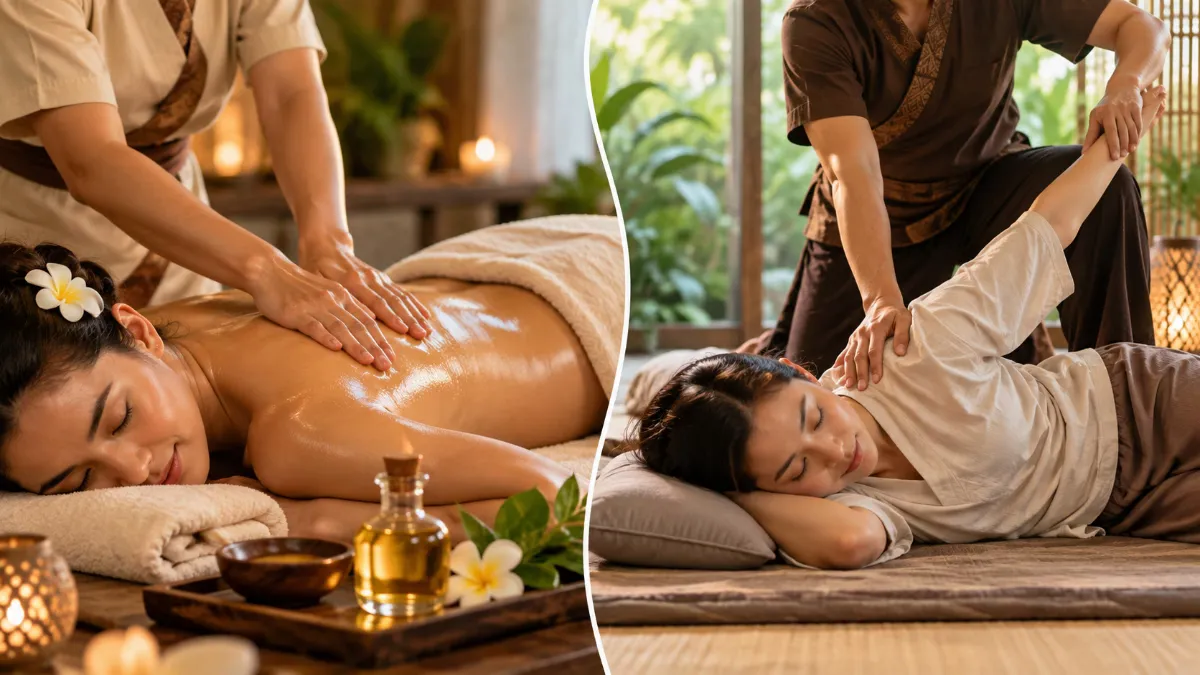
Oil does not make a massage deeper. It makes long strokes easier. By reducing friction between the therapist's palm and your skin, oil lets a single stroke travel the full length of a muscle without snagging. Those sustained gliding strokes, called effleurage, repeat in a slow rhythm that many people find deeply relaxing. Massage has been associated with short-term reductions in heart rate and anxiety, but the effect should not be reduced to a simple cortisol drop; a quantitative review of massage and cortisol found cortisol changes were generally small. The relaxation is not the oil itself. It is the uninterrupted stroke the oil makes possible.
What Dry Massage Uses Instead of a Lubricant
Dry massage replaces glide with three other tools: compression, point pressure, and assisted stretch. Without oil, the therapist's hand grips rather than slides, so the therapist can lean body weight into a knotted band, hold a thumb on a single pressure point, or lever your limb into a stretch you could not reach alone. The therapeutic effect comes from load and leverage, not flow. That more active combination of compression and assisted movement can leave some people feeling mobilised rather than sleepy.
Which Massage Modalities Are Oil-Based and Which Are Dry
Most styles sort cleanly onto one side, and the reason each sits where it does is mechanical, not stylistic.
Oil-Based: Swedish, Ayurvedic, and Aromatherapy
Swedish massage is the archetype: long effleurage over warm oil, built for circulation and calm. Ayurvedic massage uses warmed oil, often sesame, worked in slow, rhythmic strokes along the body's energy channels, so the oil is medicinal as well as functional. Aromatherapy massage layers essential-oil vapour on top of the same gliding technique, adding a scent-driven calming effect. All three need oil because the stroke, not the stretch, is doing the work.
Dry: Thai Stretching and Shiatsu; Deep Tissue Sits Between
Thai stretching massage is passive yoga: the therapist uses hands, forearms, and feet to fold and lengthen you, with no glide required. Shiatsu applies sustained thumb and palm pressure to meridian points and holds still, so glide would actually get in the way. Deep tissue work is the honest exception: it can use little or more lubricant depending on the technique and the spa. At Anura Spa, deep tissue is performed with warm oils while the therapist uses slower, firmer, more targeted pressure than in a relaxing Swedish massage.
Six Criteria That Decide Oil Massage vs Dry Massage
Before the scenarios, here is the practical side-by-side.
Criterion | Oil massage | Dry massage |
Skin effect | Can leave dry skin softer and more moisturised, depending on the oil used | No lubricant, no residue, nothing to wash off |
Pressure style | Long gliding strokes along the muscle | Compression, point pressure, assisted stretch |
Clothing | Skin exposed beneath draping | Loose clothing stays on throughout |
Primary goal | Relaxation and skin comfort | Flexibility and structural reset |
Best-suited body | Tense, stressed, dry-skinned, sleep-short | Stiff-jointed, athletic, stretch-hungry |
Aftercare | May leave oil on the skin; shower timing depends on the treatment | No oil residue or cleanup |
Skin Effect, Pressure, and the Hour Afterward
Oil can leave dry skin feeling softer and your head heavy; expect to want a nap and, depending on the treatment, a shower later. Dry work leaves nothing on the skin and can leave a loose, energised feeling in the joints that many people notice for the rest of the day. If your skin runs dry in the Kathmandu winter, oil can do double duty. For an evening with plans, dry is often the more convenient book.
Who Should Avoid Each Style
Contraindications matter here, and most spa menus skip them. If you have inflamed acne, eczema, broken skin, or a known allergy to massage oils or essential oils, tell the therapist so affected areas and unsuitable products can be avoided. Strong dry work or Thai stretching may need modification if you have acute inflammation, fragile joints from osteoporosis, or a recent sprain or fracture. If you are pregnant, tell the spa before treatment and book with a therapist trained in prenatal massage; ACOG guidance on massage during pregnancy recommends appropriate positioning and making sure the therapist knows you are pregnant. If you have a high-risk pregnancy or another medical concern, seek individual medical guidance before strong pressure or assisted stretching.
Session Length and Booking in Thamel
Session length varies by treatment and booking. Oil massages are usually performed on a padded table, while traditional Thai stretching is commonly done clothed with room for assisted movement. The practical note for dry styles: you keep loose clothing on throughout, so wear or bring something you can stretch in. Not sure which column you belong in? The massage quiz sorts it in about a minute.
When Oil Massage Is the Stronger Fit
Book oil when the goal is to come down, not to be worked on. Travel-frayed nerves, poor sleep, winter-dry skin, a body that is tense rather than acutely injured: the long effleurage stroke is built for exactly that. Oil is also the gentler first experience, which matters if you have never been on a table and do not want a stranger leaning an elbow into your back.
When Dry Massage Is the Stronger Fit
Choose dry when the problem is mechanical. Stiff hips, a back that cracks when you twist, hamstrings that have not reached your toes since school: assisted stretch and point pressure work directly on movement and range rather than relying on long gliding strokes. Dry also wins on modesty and convenience, since you stay clothed and skip the oil cleanup afterward. Regular spa-goers who already know Swedish often find a dry style is where the more interesting work begins.
Which Style Works Better After Trekking in Nepal
Two different problems walk off the trail, and they need two different answers.
The first is acute muscle soreness, the delayed-onset ache in your quads and calves a day or two after a long descent. Massage has evidence for reducing delayed-onset muscle soreness after strenuous exercise: a systematic review and meta-analysis found lower soreness ratings at 24, 48, and 72 hours, while a small 2025 randomized trial also reported favourable recovery-marker changes after massage, though its 30-participant male-only sample limits how broadly the result should be applied. For sore quads, deep tissue or firmer oil-assisted work can be a reasonable fit when the pressure is comfortable.
The second problem is stiffness and restricted movement after days under a loaded pack: tight hips, locked-feeling knees, or a seized lower back. Thai stretching may be the better tool here because assisted movement and stretching directly address mobility. For trekkers who have both soreness and stiffness, Anura Spa's Trekkers Special Massage blends deep tissue work, Swedish strokes, and assisted stretching in a 90- or 120-minute treatment. The post-trek recovery tool can help you decide what to prioritise first.
Three Travelers, Three Bookings
Find yourself below for the short version.
The first-timer with no particular complaint should book a Swedish massage. It offers a gentle introduction to being on a table without the intensity of deep point work.
The post-trek traveler with sore quads and tight hips should consider the Trekkers Special Massage, which combines firmer muscle work with Swedish strokes and assisted stretching so both soreness and stiffness can be addressed in one visit.
The regular spa-goer who already knows the oil styles and wants something genuinely different should try Shiatsu: its meridian-based point pressure is a distinct reset from Thai's passive-yoga format, and you stay clothed throughout while the session remains glide-free. For a deeper comparison of the two big dry styles, our guide to deep tissue vs Thai massage goes further.
Questions Clients Ask Before Choosing
Is Thai Massage Always Done Without Oil?
Traditional Thai massage is dry by design. The technique relies on grip, compression, and assisted stretching, so the classic floor-mat Thai session uses no lubricant. Some spas offer a separate Thai oil hybrid, but that is a different treatment format.
Can You Ask Your Therapist to Add Oil to a Normally Dry Massage?
Sometimes, but it changes the treatment. A therapist may use oil in a deep tissue session, and at Anura Spa warm oil is part of the treatment. Adding oil to traditional Thai stretching, however, reduces the grip needed for many assisted movements, so the therapist may steer you to an oil-based modality instead rather than compromise the technique.
Which Is Better for Dry or Sensitive Skin, Oil Massage or Dry Massage?
For dry skin, oil massage can be a good choice because the medium may leave the skin feeling softer and more moisturised. Sensitive or reactive skin is more nuanced: ask what carrier oil and fragrance ingredients are being used, and avoid blends you know you react to. If any oil is a problem, a dry style sidesteps the issue entirely.
Does Dry Massage Hurt More Than Oil Massage?
Dry compression and deep stretch can feel more intense, though hurt is the wrong word if the therapist is working correctly. Oil massage usually stays in a gentler, flowing range. Intensity is adjustable in both; always say when pressure crosses from productive to painful.
Which Style Recovers Sore Trekking Muscles Faster?
Massage can help reduce delayed-onset muscle soreness after strenuous exercise, but the evidence does not establish one spa style as universally fastest for every trekker. For soreness, firmer massage may suit people who tolerate that pressure; for stiffness and restricted movement, Thai-style assisted stretching may be the better fit. Many trekkers benefit from a session that combines both approaches.
Can I Book an Oil Massage If I Have a Nut or Sesame Oil Allergy?
Yes, but flag the exact allergy when you book. Ayurvedic and aromatherapy treatments can use different carrier oils and added ingredients, so ask the spa to confirm what will touch your skin. If a suitable oil cannot be confirmed for your allergy, choose a dry style instead.
Still weighing oil massage vs dry massage for your body and your week? Take the massage quiz to match your goal, skin, and comfort level to the right style before you book.