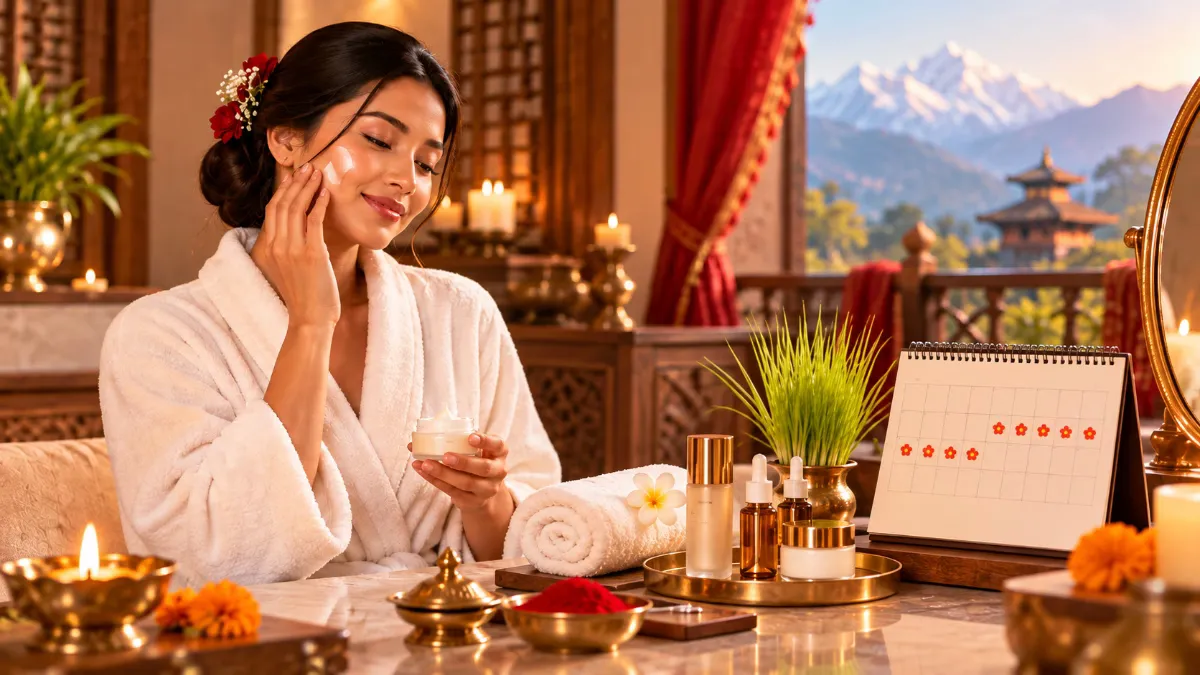
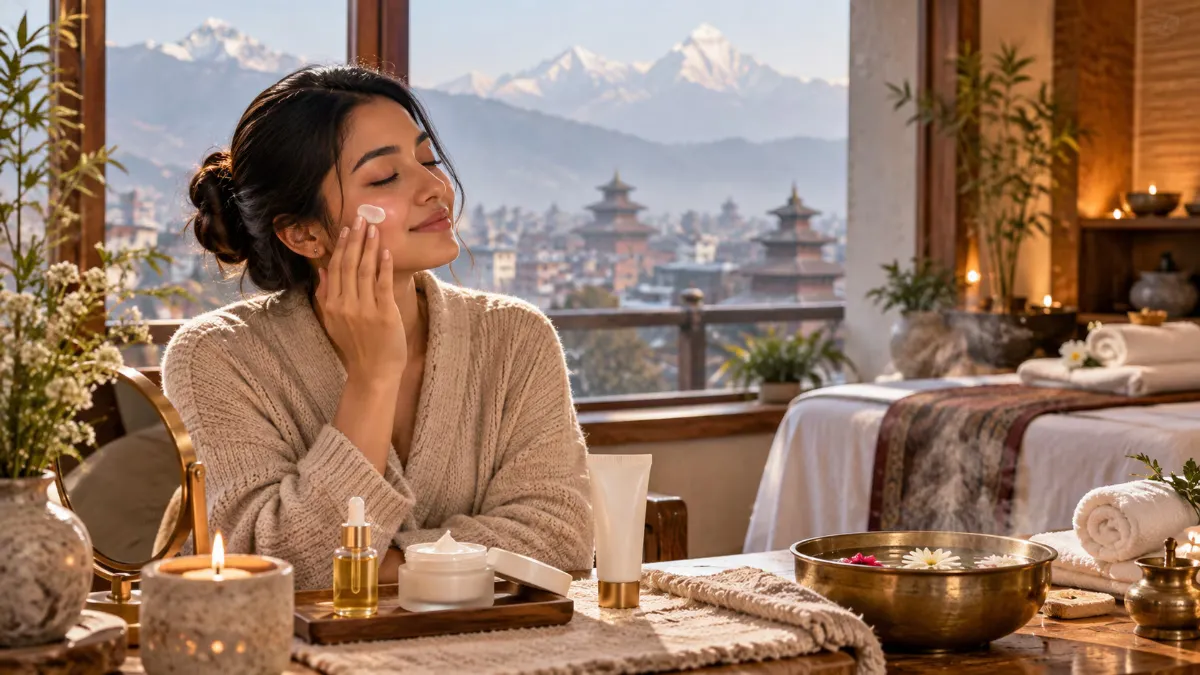
By mid-December the tap water in Kathmandu runs cold enough to sting, the afternoon air holds less than half the moisture it did in August, and the skin across your knuckles starts to split. Most winter skincare Nepal advice stops at "switch to a richer cream", exactly why it keeps failing here. Kathmandu's winter is a high-altitude, low-humidity, pollution-prone environment that draws water out of the skin barrier faster than any routine built for a temperate climate expects. This guide maps those conditions to specific steps, then draws a clear line between what a home routine can manage, where a professional cosmetic treatment may help, and when persistent skin problems deserve medical attention.
What Kathmandu's Winter Actually Does to Your Skin
Three forces act on your skin at once, and none of them is the temperature reading on your phone.
How altitude and sub-40% humidity break the barrier faster than cold
Kathmandu sits at 1,400 metres (4,600 feet). Weather records show relative humidity averages around 49% in December, with afternoon minimums that can fall below 40%, against monsoon readings above 80%. That gap matters more than the thermometer. When the surrounding air is dry, water moves out of the stratum corneum by simple evaporation, faster than your skin can replace it. Cold, dry conditions can also reduce the skin's natural surface oils, compounding the loss. The result is a barrier that loses moisture more easily, which is why a summer moisturizer can feel inadequate by January.
Winter air pollution and inversions: Kathmandu's overlooked skin stressor
Winter air pollution is the factor beauty guides here often leave out. IQAir put Kathmandu's 2024 annual average PM2.5 at 45.1 µg/m³, roughly nine times the WHO annual guideline. In winter, the bowl-shaped valley and temperature inversions can trap particulate pollution near ground level, with traffic, garbage burning, biomass burning and other combustion sources contributing to the load. On March 8, 2026, the city's air quality index passed 200, the threshold for very unhealthy air quality. Fine particulate matter has also been linked with oxidative stress and disruption of normal skin-barrier function, adding another source of stress when the air is already dry.
Why December sun still damages skin at 1,400 metres
The winter sun in Kathmandu feels mild, and that is the trap. At Nepal's altitude, a thinner atmosphere filters less UV radiation, so midday December sun can still contribute to pigmentation and cumulative UV damage. Daily SPF is not a summer habit here. It is a year-round one.
What to Stock Before a Winter Skincare Routine in Nepal
Before you touch a single step, get three functional ingredient types on the shelf. They do different jobs, and a routine that skips one can lose moisture faster.
Ceramides, humectants, and occlusives: three jobs, not one
A humectant, such as hyaluronic acid or glycerin, helps attract and hold water in the outer skin. Ceramides are barrier lipids that help support the "mortar" between skin cells. An occlusive, such as petrolatum, an oil or a butter, forms a surface layer that slows water loss. In Kathmandu's dry winter air, humectants generally work better when followed by a cream or occlusive that helps keep that hydration from evaporating. The practical order is simple: hydrate, support the barrier, then seal if your skin needs it.
Mustard oil versus sesame oil: what the evidence actually shows
Traditional oils are cheap, local and commonly used as skin sealers, but the evidence does not support declaring one of these oils universally better for an adult face. A randomised clinical trial in rural Nepal compared mustard seed oil with sunflower seed oil in newborns and found faster acid-mantle development with sunflower oil, while water-loss measures did not differ significantly. Because that study involved neonates, it should not be used as proof that mustard or sesame oil is the best choice for adult facial skin. If you use a traditional oil, choose one your skin already tolerates and patch-test first; for sensitive or acne-prone faces, a fragrance-free cream or ointment is often the more predictable winter option.
Exfoliation timing before you start
Scrubbing feels productive when skin is flaking, but it is often the wrong move. Flaking is frequently a sign the barrier is already stressed, not dead skin waiting to be sanded off. Keep exfoliation gentle and infrequent in winter, and never scrub skin that is cracked, red, stinging, sunburned or otherwise irritated.
Your Morning and Evening Face Routine for Nepal's Dry Months
Order matters more in winter than in any other season, because each layer sets up the next.
Morning: cleanse, humectant, barrier cream, SPF
Use a gentle, non-foaming cleanser, then apply a humectant serum to slightly damp skin. Follow with a ceramide-rich or otherwise barrier-supporting cream while the skin is still slightly damp. Finish with broad-spectrum SPF 30 or higher as the last step, every day, cloud or not. The whole sequence takes only a few minutes and is practical for a dry Kathmandu afternoon.
Evening: oil cleanse, repair layer, overnight lock
At night, start with an oil cleanse or another gentle cleanser that effectively removes sunscreen, makeup and the day's grime. Reapply your barrier-supporting cream, then, if your skin still feels dry, seal it with a thin layer of petrolatum or another fragrance-free occlusive you already tolerate. On nights when your skin feels tight, raw or irritated, skip strong actives such as retinoids or exfoliating acids until the barrier settles.
Body Routine for When Humidity Drops Below 40%
Your body loses the humidity battle in a specific window most people miss.
The post-shower window
Step out of a short, warm shower and your skin still holds surface moisture. Apply a cream, ointment, oil or butter while the skin is still damp, before that water has had time to evaporate. Waiting until the skin feels completely dry gives your moisturizer less water to trap. This timing change is one of the simplest ways to make a winter body routine work harder without buying more products.
Ubtan and gentle scrubbing without stripping the barrier
Ubtan, the traditional paste of chickpea flour, turmeric and a little oil, can work as a mild home exfoliant for some people, but treat it like any scrub: keep pressure light and stop if it stings or irritates. Use it only on intact skin and no more often than your skin comfortably tolerates. Never apply ubtan to broken, cracked or inflamed skin.
When a Kathmandu Spa Treatment Can Complement Home Care
For intact skin that feels rough, dull or flaky despite a consistent routine, a professional cosmetic treatment can be a useful add-on. It should not replace medical care for skin that is cracked, bleeding, painful, intensely itchy, infected-looking or covered by a persistent rash; those are reasons to see a dermatologist or other qualified medical professional.
Body scrub: smoothing rough, flaky surface skin
When intact body skin feels rough or looks dull, a professional body scrub can provide controlled surface exfoliation and leave the skin feeling smoother and softer. The benefit is cosmetic exfoliation, not treatment of an underlying skin disorder. If the skin is cracked, inflamed, sunburned or very sensitive, skip the scrub until it has recovered.
The winter facial and how often to book it
A winter facial at Anura Spa includes cleansing, gentle exfoliation, extractions where needed, facial massage and a mask matched to the skin type, followed by finishing care. That gives you a multi-step professional treatment that a single rinse-off mask at home does not replicate. Anura Spa recommends a facial roughly every four to six weeks for most skin types, with the treatment adjusted to your skin's condition and sensitivity.
Steam room: keep the session short
Heat can feel soothing in winter, but more is not automatically better for dry skin. A 2008 controlled study of regular Finnish sauna users found more stable barrier function and better water-holding capacity in regular users after two 15-minute sauna exposures at 80°C; it did not study steam rooms or prove that 15 minutes is a universal skin threshold. For a conservative spa routine, keep steam room and sauna sessions brief, leave sooner if you feel lightheaded or uncomfortable, and moisturize after bathing or showering.
What a month costs: home kit versus spa
Here is a rough cost comparison using 2026 Kathmandu price ranges. Prices vary by brand, retailer, spa and treatment length, so check current prices before buying or booking.
Option | Inputs | Cost (NPR) |
|---|---|---|
Home kit | Ceramide cream, 50g (lasts 4-8 weeks) | 337-515 |
SPF 50, 50-75ml | 575-810 | |
Barrier oil or occlusive | 100-300 | |
First-month total | roughly 1,000-1,600 | |
Professional | Body scrub, one session | 1,900-8,300 |
Winter facial, on top | varies by spa |
Because the SPF and occlusive often last beyond a month, the ongoing home cost can drop after the first purchase. A spa treatment costs more than the basic home routine, but it serves a different purpose: professional exfoliation, cleansing and cosmetic care rather than treatment of a medical skin condition.
Three Winter Skin Problems Kathmandu Residents Actually Face
Cracked heels from cold floors and wool socks
Cracked heels often sit beneath thick, dry skin, so a light lotion may not be enough. After a short warm shower or soak, apply a heel cream or rich moisturizer while the skin is still damp, then seal with petrolatum and wear cotton socks overnight. If the fissures are deep, bleeding, painful, swollen or not improving, skip aggressive filing or scrubbing and get medical advice.
Arms and legs that keep flaking regardless of lotion
Persistent flaking on limbs often means a light lotion is not occlusive enough for the season. Switch to a cream, ointment, oil or butter on damp skin after bathing. If the skin is intact and not irritated, occasional gentle exfoliation can help with surface roughness, but more scrubbing is not the answer when skin is red, stinging or cracked.
Two weeks, no improvement: reassess the problem
Give a consistent gentle home routine about two weeks. If mild dryness is improving but the skin still feels rough or dull, a professional scrub or facial may be a reasonable cosmetic add-on. If dryness is not improving, or the skin is painful, cracked, bleeding, intensely itchy, burning or developing a persistent rash, see a dermatologist rather than trying stronger exfoliation or more frequent spa treatments.
Questions About Winter Skin Care in Nepal
Why does skin get so much drier in Kathmandu winters than in summer, even indoors?
Weather records show relative humidity drops sharply from monsoon highs to much drier winter conditions, with afternoon levels that can fall below 40%. Dry air increases water loss from the outer skin, and indoor heating can lower room humidity further, so the drying continues inside.
Is mustard oil safe to use on your face in Nepal's winter, or does it clog pores?
There is not good evidence that a general "comedogenic rating" can predict how every person's face will react to a particular oil. The Nepal trial often cited in this context compared mustard and sunflower oils in newborns, not adults, so it cannot establish which traditional oil is best for an adult face. If you use mustard, sesame or another facial oil, patch-test it and stop if you develop stinging, redness or breakouts. Sensitive or acne-prone skin may do better with a fragrance-free, non-comedogenic cream or ointment.
How often should someone in Kathmandu book a professional body scrub during winter months?
For most people with intact skin, every three to four weeks is a reasonable spa cadence, and Anura Spa gives the same general interval for its body scrub service. More frequent scrubbing is not necessarily better: if your skin is cracked, inflamed, very sensitive or persistently itchy, pause exfoliation and address the skin problem first.
Does a steam room session help or hurt dry winter skin in Nepal?
A short heat session may feel comfortable, but the available 2008 study often cited for skin-barrier benefits was a Finnish sauna study, not a steam-room trial. It does not establish that dry skin improves for exactly 10 to 15 minutes or worsens immediately after that point. Keep sessions brief, leave if you feel unwell, and apply moisturizer to damp skin afterward.
Do you still need SPF in Nepal during December and January?
Yes. Higher altitude means less atmosphere is available to absorb UV radiation, and UV exposure still accumulates in winter. Use broad-spectrum SPF 30 or higher as part of the morning routine year-round, especially when you will spend time outdoors.
What does a winter facial at a Kathmandu spa do that a home face mask cannot?
A professional facial combines several steps in one session: cleansing, exfoliation, extractions where needed, massage, a mask selected for the skin type, and finishing care. A home mask is only one step. The spa treatment can improve the feel and appearance of intact skin, but it is not a substitute for medical treatment of eczema, dermatitis, infection or another persistent skin condition.
If two weeks of the home routine above leave otherwise healthy skin feeling rough, dull or flaky, a professional body scrub or winter facial can be a useful cosmetic add-on. If the skin is cracked, bleeding, painful, intensely itchy or affected by a persistent rash, see a dermatologist instead. See what Anura Spa's body scrub and facial treatments include.