
You come off the Annapurna Circuit with calves that seize on every staircase, or you have spent a decade at a Kathmandu desk and your lower back has stopped forgiving you by Wednesday. Either way, the deep tissue vs Thai massage decision is the one thing standing between you and actual relief, and most comparison pages abandon you right where you started, with a shrug and "it depends on your needs." It does depend, but not on a vague sense of preference. It depends on one clear split: is your problem a localized knot that needs pressure, or a full-body stiffness that needs to be stretched open? Answer that and the booking answers itself.
What actually separates deep tissue from Thai massage
Oil and clothing are not the real difference. Direction and reach are. Deep tissue works vertically, driving into one muscle group until the tension gives. Thai works horizontally, mobilizing the whole posterior chain, hips, hamstrings, spine, and shoulders, as one connected system.
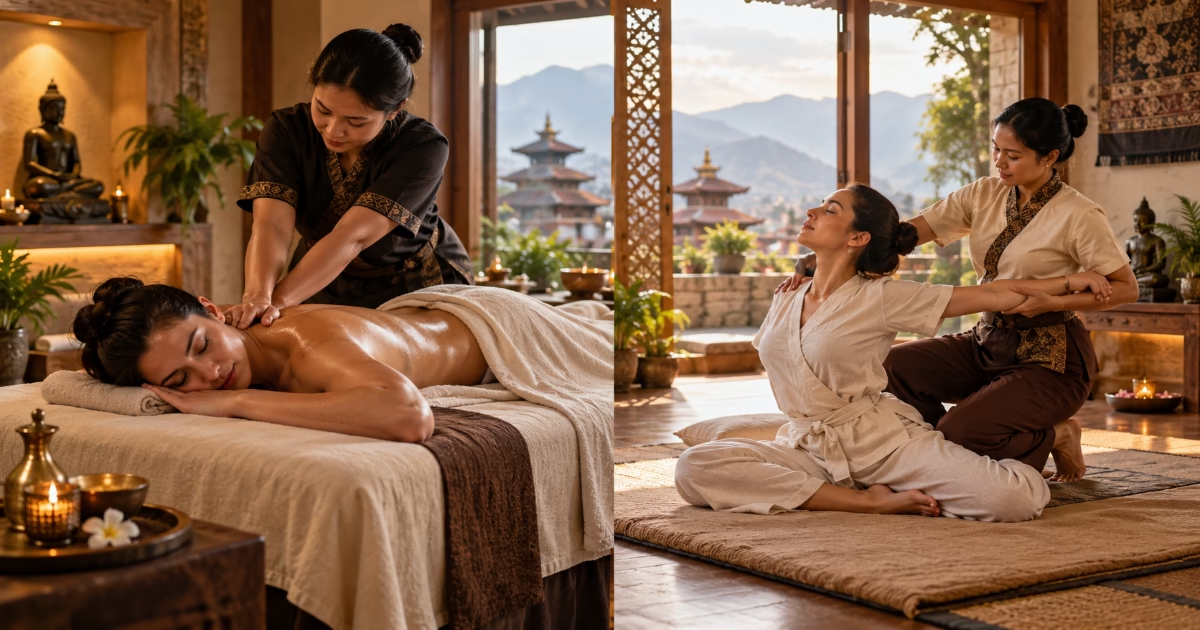
Deep tissue massage uses slow cross-fiber strokes, sustained elbow and thumb pressure, and trigger-point release aimed at the muscle layers sitting beneath the superficial tissue. You lie undressed on a table; the therapist uses oil to glide and then anchor, and a session typically runs 60 to 90 minutes. The sensation is specific and firm. When a therapist finds your knot, you know it.
Thai massage takes the opposite approach. Fully clothed on a floor mat with no oil, you move through passive assisted stretches while the therapist applies rhythmic palm and thumb compression, using their own body weight to rock and lengthen you along the body's energy lines. It has been called assisted yoga for good reason. Sessions also run 60 to 90 minutes, but you leave them feeling lengthened rather than worked-over.
If you want the full technique breakdown, our deep tissue massage and Thai stretching massage pages walk through each one, and you can book either directly from there once you have read the rest of this.
How they compare on five booking decisions
Back pain and chronic muscle knots
Generic comparison pages fail you most here: they treat "back pain" as one problem. At minimum, it is two.
Lower back discomfort can sometimes occur alongside tight hips, hamstrings, and reduced mobility, so focusing only on the sore area may not address the broader stiffness a person is experiencing. Thai massage may be particularly useful when lower-back discomfort comes with general tightness or limited range of motion because assisted stretching and compression work across multiple connected areas of the body. Buttagat et al. (2011, Journal of Bodywork and Movement Therapies, n=36) found that a single 30-minute traditional Thai massage session significantly reduced pain intensity, anxiety, and muscle tension while improving flexibility and pressure-pain threshold in participants with back pain associated with myofascial trigger points, compared with a resting control group.
Upper back pain is a different animal. Desk posture contracts the rhomboids, traps, and levator scapulae into specific, palpable knots. Deep tissue's cross-fiber pressure is the more precise tool for that kind of targeted problem. Stretching helps the region, but it will not dig the adhesion out of a rhomboid the way a thumb held on it for ninety seconds does. For a fuller treatment of the options, see our guide to the best massages for back pain relief.
Post-trek and post-exercise recovery
Trekking loads the body in a pattern the gym never replicates. Long descents place repeated demands on the thighs and calves, while days of climbing, uneven trails, and long hours on your feet can leave the hips, legs, and ankles feeling stiff. When stiffness and restricted mobility are the main complaints, Thai stretching can be a particularly useful post-trek choice because it combines assisted stretching with pressure and movement across multiple areas of the body.
Deep tissue becomes more relevant when the issue is localized muscular tightness, such as one stubborn calf or a persistent shoulder knot. Sharp pain, swelling, bruising or suspected injury should be assessed rather than aggressively massaged.
Flexibility and range of motion
For mobility rather than pain relief, the choice is not close. Thai massage is built entirely around passive stretching, so it directly improves range of motion in a way deep tissue does not aim to. Deep tissue can free a muscle that is limiting you, but it releases; it does not lengthen. Book Thai when you want to move better, not just hurt less.
First-timer comfort and session setup
Nervous about your first booking? The practical differences matter more than most people expect. Thai means staying fully clothed, so bring loose, comfortable clothes and expect to be moved, folded, and stretched on a mat at floor level. No undressing, no oil. Deep tissue means undressing to your comfort level under a sheet, oil on the skin, and lying still on a table while the pressure comes to you. Neither is wrong for a beginner, but if being touched with oil while undressed feels like a lot, Thai removes that barrier entirely. Unsure how hard is too hard? Our massage pressure levels guide sets expectations before you go in.
Post-session soreness expectations
Some people experience temporary soreness after deep tissue massage, especially after firm work on tight areas. Mild soreness may last from several hours to a day or two, but soreness is not required for a massage to be effective. Thai massage can also feel intense, although its emphasis is more on assisted movement and stretching than sustained deep pressure.
That difference can matter when timing a session around travel. If you are flying home or taking a long ground journey soon afterward, tell your therapist about your plans and avoid pressure that leaves you overly tender. If you are already sore from trekking, Thai stretching or a gentler massage may be more comfortable than very firm deep tissue work.
Which massage fits your situation
Deep Tissue Massage: best for localized pain and stubborn knots
Book deep tissue when your problem has an address. Chronic desk tension parked between your shoulder blades, a specific area of muscular tightness after sport or trail, a knot that has outlasted a week of stretching and heat. If you can point to the exact tight spot, deep tissue may be the technique that targets it most directly. Accept the trade-off: you may feel temporarily sore afterward.
Thai Stretching Massage: best for full-body stiffness and mobility
Book Thai when the problem is everywhere and nowhere. General post-trek stiffness, a lower back complaining because your hips are locked, a flexibility deficit you want to chip away at, or a pre-travel day when you cannot afford next-day soreness. For first-timers uneasy about a massage table, it is also the gentler introduction. You will leave looser rather than tenderized.
Still torn between them? Our massage quiz maps your specific complaint to a recommendation in a couple of minutes.
Where Swedish massage fits if neither seems right
Sometimes the honest answer is neither. Not carrying a specific injury, not needing aggressive work, and mostly wanting to unwind and reset? Swedish is the better fit. It uses lighter, flowing pressure for relaxation rather than deep release or deep stretching. We compare it directly with deep tissue in our Swedish massage vs deep tissue guide, but here is how all three line up:
Deep Tissue | Thai | Swedish | |
|---|---|---|---|
Technique | Sustained cross-fiber pressure, trigger-point release | Assisted stretching, rhythmic compression | Light gliding strokes, kneading |
Pressure level | Firm to very firm | Moderate, applied through stretch | Light to moderate |
Clothing | Undressed, oil, table | Fully clothed, no oil, mat | Undressed, oil, table |
Best use case | Localized pain and stubborn knots | Full-body stiffness and mobility | Relaxation and stress relief |
Five questions to ask before you book
Run through these and the choice usually makes itself:
1. Can you point to the exact spot that hurts, or is it a general stiffness? A precise spot leans deep tissue; general stiffness leans Thai.
2. Is the goal less pain or more movement? Pain relief can go either way; mobility means Thai.
3. Are you traveling within 48 hours? If yes, book Thai so soreness does not follow you onto the plane.
4. Is this your first massage, and does undressing worry you? Thai keeps you clothed.
5. Did the pain start after trekking or hard exercise? Whole-body loading favors Thai; a single overused joint favors deep tissue.
What readers ask about deep tissue vs Thai massage
Is Thai massage as painful as deep tissue massage?
Usually no. Thai can feel intense at the edge of a deep stretch, but it rarely produces the concentrated ache of sustained deep tissue pressure, and it seldom leaves next-day soreness. Deep tissue is the more uncomfortable of the two, both during and after the session.
Which is better for lower back pain: deep tissue or Thai massage?
When lower back pain comes with general stiffness or limited mobility, Thai massage may be a good fit because it combines assisted stretching and compression across multiple areas. If the discomfort is more localized muscular tension or a palpable knot, deep tissue may target that area more directly.
Can I book a deep tissue session and a Thai session on the same visit?
Yes, and it can work well as long as the sequence is sensible. Many people do Thai first to open up range of motion, then deep tissue to target a specific problem area. Space them out or split them across a longer appointment so you are not overloading one region.
How do I know if my body needs pressure work rather than stretching?
A single tight muscle or persistent knot often leans toward deep tissue. General tightness, stiffness, or restriction across a whole region or the full body often leans toward Thai stretching.
Which massage is better after trekking in Nepal?
There is no single best massage after a trek. Thai stretching may suit stiffness and restricted mobility; deep tissue may suit persistent localized muscular tightness; and Swedish can be a better fit for general tiredness or tenderness. If an area is sharply painful, swollen, bruised, or appears injured, get it assessed rather than choosing stronger massage.
The deep tissue vs Thai massage choice comes down to one honest read of your own body: a specific spot that needs pressure, or a whole system that needs to open up. Browse Anura Spa's deep tissue and Thai massage services and book the session that matches the problem you actually have.


