Six days on the Everest Base Camp trail can leave your hips and legs feeling tight after thousands of loaded uphill and downhill steps. The Kathmandu spa menu offers two clothed, oil-free treatments you have heard of but never quite pictured. Shiatsu vs Thai massage is a genuine fork in the road, not a coin toss, because the two styles apply very different kinds of force to your body. One presses and holds. The other stretches and moves you. Knowing which experience better matches what your body needs is the difference between a session that feels targeted and one that simply feels pleasant for an hour.
Both are typically performed fully clothed, on a floor mat, with no oil. That rules out the Swedish-style glide most travelers expect. What separates them is everything that happens once you are lying on that mat.
Shiatsu vs Thai Massage: Six Factors Compared
The table below is the fast version. The two rows on pressure type and what each style is often chosen for are the ones that usually make the booking decision easiest.
Factor | Shiatsu | Thai massage |
|---|---|---|
Pressure type | Sustained, focused point pressure | |
Point hold and motion | Often stationary holds with little or no sliding | Flowing sequential compressions along traditional Sen lines |
Use of oil | Typically none | Typically none |
Clothing | Typically fully clothed | Typically fully clothed |
Session position | Mostly still, lying on a mat | Repositioned and stretched throughout |
Traditional framework | Meridian and tsubo concepts | Sip Sen concepts |
Often chosen for | Localized pressure and a quieter session | Whole-body mobility, stretching, and stiffness |
Sustained point pressure vs rhythmic compression and stretching
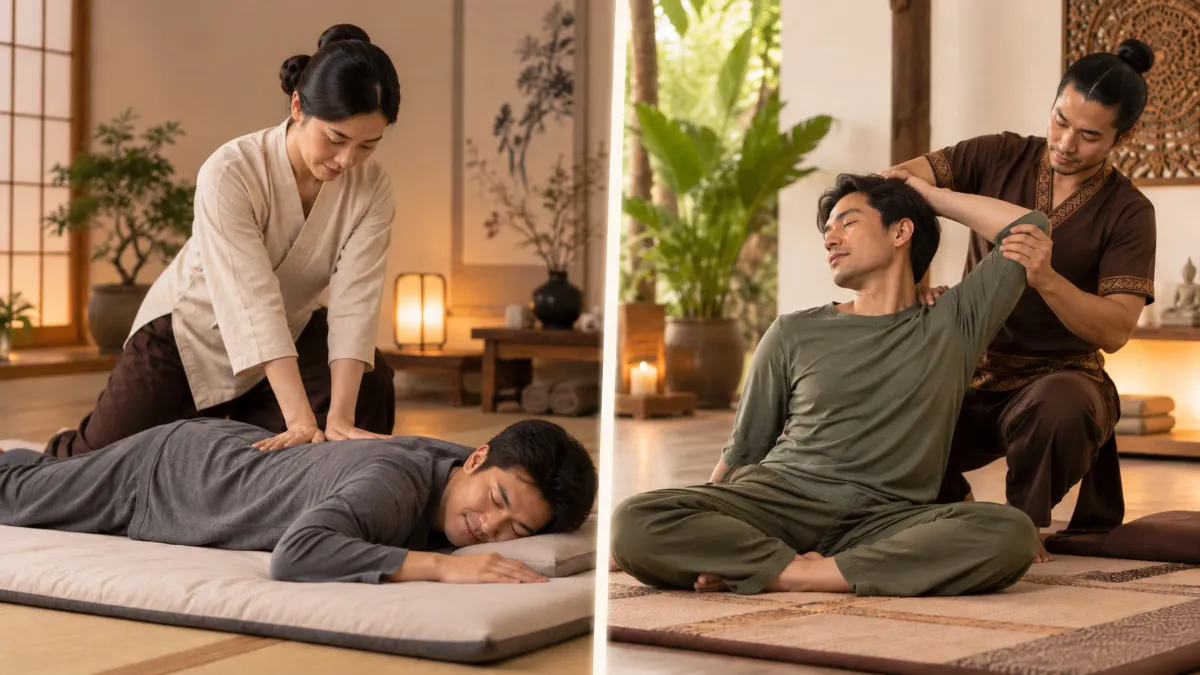
This is what you will actually feel. In shiatsu, the therapist locates a point or area, leans perpendicular weight into it, and often holds for several seconds with little or no sliding movement. You feel a slow, sinking, focused pressure that stays put. Thai massage covers the same region differently: a wave of rhythmic thumb and palm compressions travels along the body, so the pressure flows rather than parks. Then come the assisted stretches, where the therapist moves your limbs through a controlled range of motion.
Session setup, clothing, and physical demand on the receiver
Because both are commonly clothed, mat-based, and oil-free, the logistics can look identical from the booking page. The physical demand on you is not. Shiatsu generally asks less movement from you; lying still and receiving is much of the experience. Thai massage is more interactive: your body may be folded, rotated, and extended throughout the session, which can feel invigorating for some and unfamiliar to a first-timer who expected to switch off. If the idea of being moved into assisted stretches makes you tense up, that reaction is useful information when choosing.
Which body complaints each modality is often chosen for
Concentrated pressure on one area plays to shiatsu’s more localized style, which may appeal to people with persistent neck, shoulder, or back tightness who prefer a quieter session. Thai massage combines compression with assisted movement, so it is often chosen for stiffness, restricted-feeling movement, and the whole-body tightness that can follow hard physical effort. Neither is stronger in the abstract; they are different experiences suited to different goals.
The Origin Gap: Japan’s Tsubo Points vs Thailand’s Sen Lines
Both traditions use traditional frameworks that describe the body through networks of pathways, but they map and work with those pathways differently. These meridian and Sen concepts belong to their respective traditional systems and should not be treated as established anatomical structures.
How shiatsu developed from Japan’s anma tradition
Shiatsu grew out of anma, Japan’s older hands-on massage form, and took a named shape in 1919 when Tamai Tempaku published Shiatsu Ho (“finger pressure method”). Tokujiro Namikoshi opened his first clinic in Hokkaido in 1925 and built a system grounded in musculoskeletal anatomy and Western physiology. Japan’s government licensed the Japan Shiatsu School in 1957, and the Ministry of Health formally recognized shiatsu as a therapy distinct from anma and Western massage in 1964.
One detail matters when you book: “shiatsu” is not a single school. Shizuto Masunaga reintegrated classical meridian concepts into what became Zen Shiatsu; Katsusuke Serizawa focused on tsubo acupoints. A session can feel more anatomically focused or more channel-oriented depending on which tradition your therapist practices. Worth asking.
Classical shiatsu uses fingers, thumbs, and palms to apply sustained pressure to specific points and areas of the body. In many styles, the pressure is applied perpendicular to the skin with little or no gliding movement.
How Thai massage grew from Ayurvedic and Buddhist healing
Thai massage, or nuad boran (“ancient massage”), developed within traditional Thai healthcare, shaped by Buddhist beliefs and influences from Indian medical traditions. It is often described in Western spas as “Thai yoga massage.” Although claims that the practice dates back 2,500 years are common, its precise origins are difficult to establish. A clearer modern milestone is its international recognition: UNESCO inscribed Nuad Thai on its Representative List of the Intangible Cultural Heritage of Humanity in 2019.
In traditional Thai healthcare, Nuad Thai is commonly described through the Sip Sen, or principal Sen lines. Practitioners use rhythmic compressions and manual pressure, then move the limbs through assisted stretches and positions that may resemble supported yoga postures.
Shiatsu: Often Chosen for Localized Tension and a Quieter Session
Shiatsu can be a good match when your main preference is focused pressure in one region without much repositioning.
Chronic neck and shoulder tension, relaxation, and sleep concerns
A desk worker with long-standing neck and shoulder tightness may prefer shiatsu because the treatment can spend more time applying sustained pressure to specific areas rather than moving continuously through a full-body stretch sequence. Its quieter, more stationary character may also appeal to people who want a deeply relaxing session.
Research on shiatsu remains limited. A 2019 randomized study found that shiatsu added to standard care improved some outcomes in people with chronic low-back pain, but that does not establish shiatsu as superior to other massage styles or as a treatment for every type of pain, headache, or sleep problem. The U.S. National Center for Complementary and Integrative Health also notes that evidence for massage in several pain conditions is generally limited or low in strength.
For targeted point-focused work on the neck and shoulders, Anura Spa’s Acupressure Shiatsu is built around this kind of experience.
When to avoid shiatsu: inflammation, open wounds, or fever
Avoid direct massage pressure over acutely inflamed areas, open wounds, skin infections, or other visibly injured tissue. If you have a fever or feel acutely unwell, postpone the session until you have recovered. If you are unsure whether massage is appropriate for a medical condition, discuss it with a qualified health professional first. NCCIH provides similar safety guidance for massage therapy.
Thai Stretching Massage: Often Chosen for Mobility and Post-Trek Stiffness
For many trekkers, the practical question is whether the main goal is concentrated pressure or a session that also includes assisted movement and stretching.
Post-trekking soreness, tight hips, and restricted-feeling movement
Multi-day Nepal treks like Everest Base Camp and the Annapurna Circuit can leave the calves and thighs fatigued, the hips feeling stiff, and the hamstrings and lower back tight after repeated climbs, descents, and hours under a pack. Because Thai massage combines compression with assisted stretching and joint movement, it may appeal more to someone whose main goal is whole-body mobility rather than concentrated point pressure.
There is some limited exercise-recovery research supporting this general direction. A 2024 randomized controlled trial in 54 healthy adults found that 30 minutes of traditional Thai massage improved short-term recovery measures after exercise-induced calf fatigue compared with a control condition. The study was not conducted on trekkers, so it should not be read as proof that Thai massage speeds recovery after an Everest Base Camp trek specifically.
Anura Spa’s Thai Stretching Massage is designed around this more movement-focused, full-body style. For a fuller primer, see what is Thai massage.
When to skip Thai massage: acute injuries or joint hypermobility
A fresh injury should not be pushed into deep assisted stretching. If you have a recent muscle tear, sprain, obvious swelling, sharp pain, or difficulty bearing weight, postpone vigorous massage and seek appropriate medical assessment when needed. If your joints are hypermobile, tell the therapist so stretches can stay comfortably within your normal range rather than being pushed to end range.
Choosing Shiatsu or Thai Massage for Your Specific Situation
Four common situations, mapped to the style that may better match the experience you want.
Returning from an Everest Base Camp trek: Thai massage may be the better match if you are generally tired and stiff, have no acute injury or swelling, and want assisted movement and stretching across the whole body.
Office worker with chronic neck tension: Shiatsu may suit you if you prefer sustained, localized pressure and less repositioning than a full-body Thai sequence.
Guest seeking a quieter, less movement-focused session: Shiatsu. Its stiller format may be more appealing when relaxation and minimal repositioning are the priority.
First-time guest who dislikes being moved around: Shiatsu. You generally remain more passive throughout, with less limb repositioning than in Thai massage.
Ask whether your body and preferences call for point-specific pressure or more whole-body movement. Post-trek stiffness and mobility goals often lean toward Thai; localized pressure and a quieter session often lean toward shiatsu.
Shiatsu and Thai Massage: Your Questions Answered
Is shiatsu or Thai massage better for back pain?
Neither style has been established as universally better for back pain. If you prefer concentrated pressure while remaining relatively still, shiatsu may match your preference. If your main complaint is stiffness and you want assisted movement and stretching, Thai massage may feel more suitable. The 2019 shiatsu study above reported improvements when shiatsu was added to standard care for chronic low-back pain, while NCCIH notes that evidence is insufficient to show that one massage type is more effective than another for low-back pain.
Do I need to be flexible to receive a Thai massage?
No. You do not need to arrive flexible. The therapist controls the depth and range of each assisted stretch, and you should communicate if anything feels too intense, painful, or outside your comfortable range.
Which uses more pressure: shiatsu or Thai massage?
Shiatsu often delivers more concentrated pressure on a single point or small area. Thai massage tends to spread pressure across broader areas and adds assisted movement and stretching, so the session can feel more physically active even when the pressure itself is not as pinpointed.
Can I book shiatsu or Thai massage on the same day I finish a trek?
Often, yes, if you are simply tired or stiff and have no fever, acute injury, sharp pain, or obvious swelling. A gentle or moderate session may feel good after trekking, but massage should not be used to push through an injury. If a joint is swollen, pain is sharp, or you feel unwell, postpone the session and seek medical advice when appropriate.
How long should a first-time shiatsu or Thai massage session be?
Sixty minutes is a sensible starting point for many first-time guests. Thai massage is also commonly offered in longer sessions because full-body compression and stretch sequences take time, but the best duration depends on your comfort, goals, and the treatment menu available.
Still unsure which style fits your body today? Take the free Massage Quiz at Anura Spa to get a personalised recommendation in under two minutes.