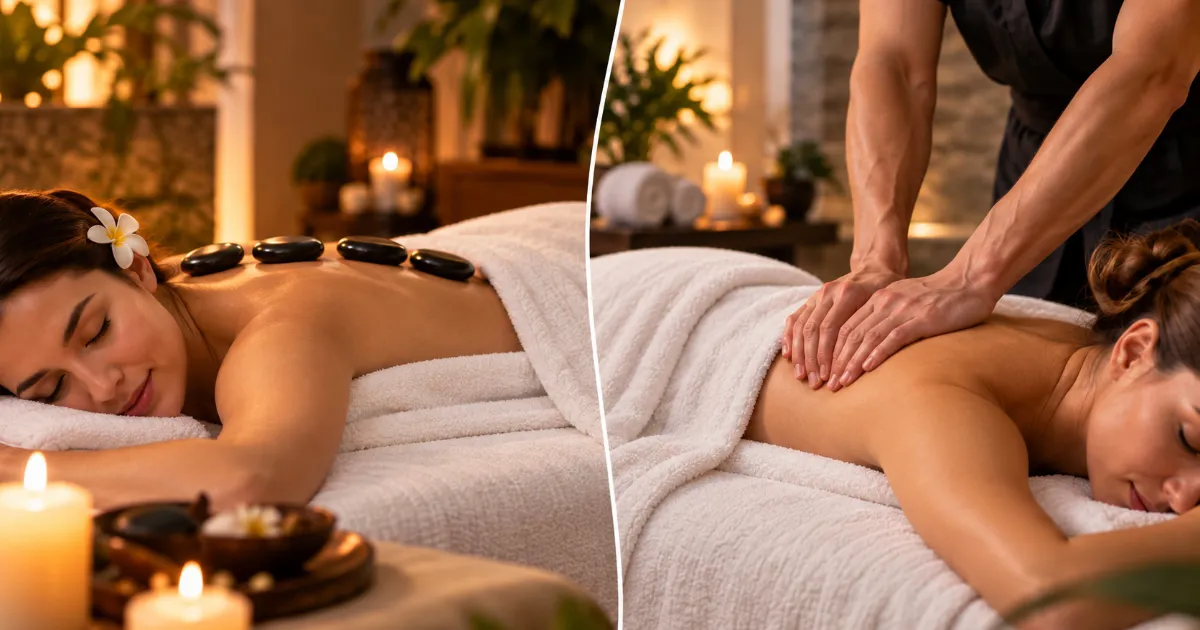
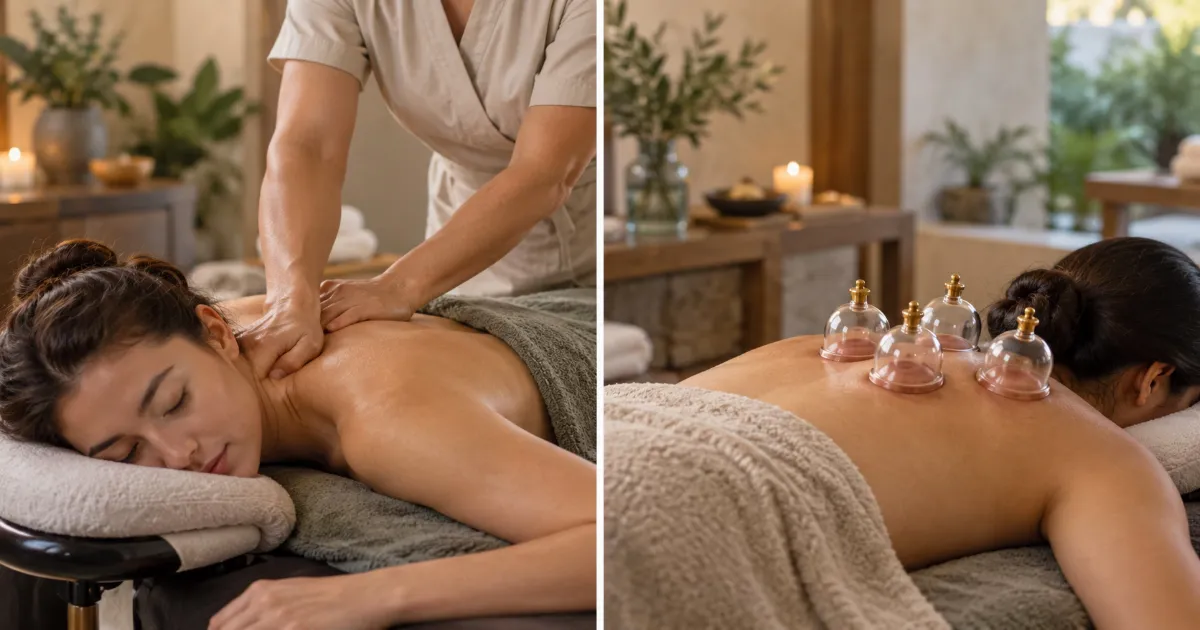
Deep tissue massage uses slow, targeted pressure and generally suits people who want focused work on specific muscular tightness. Cupping uses suction instead of downward pressure and may suit people who prefer a different sensation or want to avoid intense manual pressure. Cupping commonly leaves temporary circular marks; deep tissue is more likely to leave temporary muscular tenderness.
You have booked deep tissue before, so you already know how that table feels. Cupping is the variable you are still weighing. Most cupping vs deep tissue massage comparisons stop at the mechanics: one pushes down, one pulls up. The decision, though, lives in the 48 hours after your session, and that is what this guide is built around.
What Separates Cupping from Deep Tissue at the Tissue Level
The two treatments move your tissue in opposite directions. Deep tissue applies pressure down into the muscle and surrounding soft tissue. Cupping creates suction that lifts the skin and superficial tissue upward. That contrast, compression against decompression, explains much of what follows: how each one feels, what it leaves behind, and which style may better match your goal.
How Deep Tissue Targets Tight Muscles and Trigger Points
Deep tissue works with positive pressure. A forearm, elbow, or thumb loads weight into a tight band of muscle and holds or moves slowly until the area begins to ease. We cover the approach in our deep tissue vs Thai massage comparison, so the short version here: sustained pressure targets areas of muscular tightness, including the ropey trigger points people often feel in the upper trapezius, rhomboids, and glutes. Direct, mechanical, specific to one spot.
How Cupping Uses Suction and Affects Superficial Tissue
Cupping reverses the vector. A cup creates negative pressure that lifts the skin and superficial soft tissue into the dome. The suction can temporarily change local blood flow and the way the tissue feels, although the exact mechanisms behind cupping-related pain relief are still being studied. Some therapists describe cupping as deep tissue in reverse: useful shorthand for the upward pull, but not a literal explanation of everything happening underneath the cup.
What Each Treatment Feels Like from Start to Finish
Pain, Pressure, and Soreness During Deep Tissue
During the session, deep tissue reads as pressure that verges on ache. A good therapist works at the edge of what you can breathe through, easing off when you tense and returning once you settle. Specific points can light up with that "hurts good" sensation over a tight or sensitive area. The intensity stays active and localized throughout, and you remain engaged with it the whole way.
Suction, Warmth, and Stillness During Cupping
Cupping feels almost nothing like that. The initial suction registers as a firm tug, a stretch pulling upward rather than a press pushing in. Then the cups sit. Where they stay in place, warmth and a tight, full sensation can develop beneath them. Where the therapist glides them across oiled skin, the result becomes a broad, dragging stretch. Many guests find the sensation more passive than deep tissue pressure.
Dry Cupping vs Wet Cupping: What Day Spas Typically Offer
Two methods exist, and the distinction matters before you book. Dry cupping uses suction only, without intentionally breaking the skin. Wet cupping adds small skin incisions so blood can enter the cup, which adds infection-control and blood-exposure risks. Spa cupping is typically dry cupping; any treatment involving intentional blood removal requires appropriate training, hygiene protocols, and a setting equipped to manage those risks.
What Your Body Shows in the 48 Hours After Each Session
Post-session effects are where cupping and deep tissue diverge most sharply, and where the practical decision usually gets made.
Deep Tissue Soreness: What to Expect Afterward
Deep tissue can trade comfort now for tenderness later. Some people feel temporary soreness or sensitivity later the same day or the next day, particularly after a firm or unfamiliar session, while others feel very little. The timing and intensity vary with the person, the area treated, and how forceful the work was. Nothing usually shows on the skin, so you can walk into a meeting the next morning and no one is any the wiser.
Cupping Marks: What They Are and How Long They Persist
Cupping makes a different trade: the most obvious after-effect is often visible circular discoloration. Depending on the response, cupping marks can include redness, petechiae, or ecchymosis caused by suction affecting small superficial blood vessels. Their color is not a reliable test of "toxins," poor circulation, or the severity of a problem; mark intensity can vary with suction strength, treatment duration, skin characteristics, and individual response.
Clinical references commonly describe cupping marks as fading over roughly one to ten days. If the treatment area will be exposed for a wedding, photos, swimming, or another event, build in about a week of buffer.
Cupping vs Deep Tissue Massage: Six Differences Compared
The full comparison in a single view:
What differs | Deep tissue massage | Cupping |
|---|---|---|
Mechanism | Slow, targeted compression and manual pressure | Negative-pressure suction that lifts superficial tissue |
In-session feel | Deep, aching pressure on specific areas | Firm upward tug, warmth, and stillness |
Visible marks | Usually none | Circular red or purple marks may remain for several days |
Post-session effects | Temporary tenderness or soreness can occur; timing varies | Visible marks are common; some people also feel temporary tightness or tenderness |
Main cautions | Avoid forceful work over acute injury or open wounds; people with bleeding disorders or taking anticoagulants should avoid forceful/deep tissue massage unless medically cleared | Avoid over broken or inflamed skin, varicose veins, or suspected blood clots; anticoagulants, bleeding disorders, and pregnancy require medical guidance |
Optimal booking timing | Leave recovery time before a major physical demand if you tend to get sore | Avoid close to events where visible marks would matter |
Deep Tissue Massage Works Best for Chronic Muscle Knots
Book deep tissue when the problem feels like a specific, stubborn area of muscular tightness you can point to: months of desk posture locking the levator scapulae, or a pack strap that has left your upper traps in a permanent shrug. Targeted pressure can focus on that muscle and the sensitive point within it. The tradeoff is honest: you may accept temporary tenderness afterward in exchange for work that lighter pressure does not provide. Skip forceful deep tissue over an acute injury, recent fracture, open wound, or acutely inflamed area. If you have a bleeding disorder or take anticoagulant medication, vigorous or deep tissue massage should generally be avoided unless your healthcare professional says it is appropriate.
Cupping May Suit Broad Tightness and Post-Exercise Recovery
Cupping can be considered when the issue feels broad rather than concentrated in one hard spot: a back that feels generally tight, tired legs after repeated loading, or muscular soreness after exercise. A 2025 study of 55 healthy men aged 18 to 25 found that the strongest negative-pressure cupping group reported 24-hour soreness scores of about 1.6 compared with about 6.1 in the control group after a high-intensity exercise protocol. Those were young male participants under a specific laboratory-style protocol, not trekkers or the general spa population, so the numbers are suggestive rather than a promise. Overall research on cupping remains mixed, but the study supports further interest in its role in short-term post-exercise soreness.
Cupping's contraindications need careful screening. Do not place cups directly over varicose veins, broken or inflamed skin, open wounds, or an area where a blood clot is suspected. If you take anticoagulants or have a bleeding or clotting disorder, cupping should generally be avoided unless a healthcare professional specifically clears it. Research on cupping during pregnancy is limited, so pregnancy also calls for medical and practitioner guidance rather than routine treatment. Active eczema or psoriasis makes the affected skin unsuitable for cupping.
When Booking Both in One Session Is Worth It
For some guests, cupping and deep tissue can be used in the same session when different areas call for different sensations or techniques. Some therapists use cupping first and manual deep tissue work afterward, but the exact order should depend on the treatment goal, the areas involved, and how your body responds rather than on a fixed rule.
Consider a guest just back from Everest Base Camp. Two weeks under a loaded pack may leave the upper back and shoulders with focused muscular tightness, while long descents can leave the calves and IT-band region feeling tired and restricted. Both treatments can have a role: cupping may be used over appropriate areas of the legs for a different, less compressive sensation, while Trekker's Special Massage or focused deep tissue work can target the upper traps and rhomboids where the pack created sustained load. The main complaint should guide the choice.
One important exception: new, pronounced, or one-sided leg swelling, especially with warmth, redness, unusual pain, chest pain, or breathing difficulty, should be medically assessed rather than treated as ordinary post-trek muscle fatigue.
Common Questions About Cupping and Deep Tissue Massage
How long do cupping marks last, and will they be visible at work?
Most cupping marks fade within roughly one to ten days. Their darkness does not reliably tell you how severe a muscle problem is or exactly how long a mark will last. They typically appear where clothing can cover them, such as the back, shoulders, or legs, so office wear may hide them easily. If you will be in short sleeves or swimwear, build in about a week of buffer.
Does cupping hurt more than deep tissue massage?
For many people, cupping feels gentler during the session because it creates an upward pull rather than concentrated downward pressure. Deep tissue is more likely to produce the deep, aching sensation associated with focused pressure. Afterward, deep tissue may leave temporary tenderness, while cupping is more likely to leave visible marks. Individual responses vary.
Which treatment is better for recovery after high-altitude trekking?
It depends on the complaint. Broad lower-leg tightness or post-exercise fatigue may make cupping worth considering, while specific upper-back and shoulder tightness from carrying a loaded pack may be better suited to deep tissue work. Many trek returnees can use both approaches as part of recovery, but the order and areas treated should be individualized. Pronounced or one-sided swelling should be medically assessed rather than treated as routine muscle soreness.
Can cupping and deep tissue massage be combined in one session?
Yes. They can be combined when the therapist has screened for contraindications and the two techniques suit different treatment goals or areas. Some therapists use cupping before deeper manual work, while others adjust the sequence based on comfort and response. The combination does not need to follow one fixed order to be useful.
Is cupping safe if I take blood thinners or have sensitive skin?
If you take anticoagulants or have a bleeding or clotting disorder, cupping should generally be avoided unless your healthcare professional specifically clears it. Active eczema, psoriasis, infection, broken skin, or open wounds also make the affected area unsuitable for cupping. Tell your therapist about medications and skin conditions before the session so the safest option can be chosen.
Still weighing which one fits your goals? Compare our cupping and deep tissue massage options side by side, or take the massage quiz to match the right treatment to your session goals.