
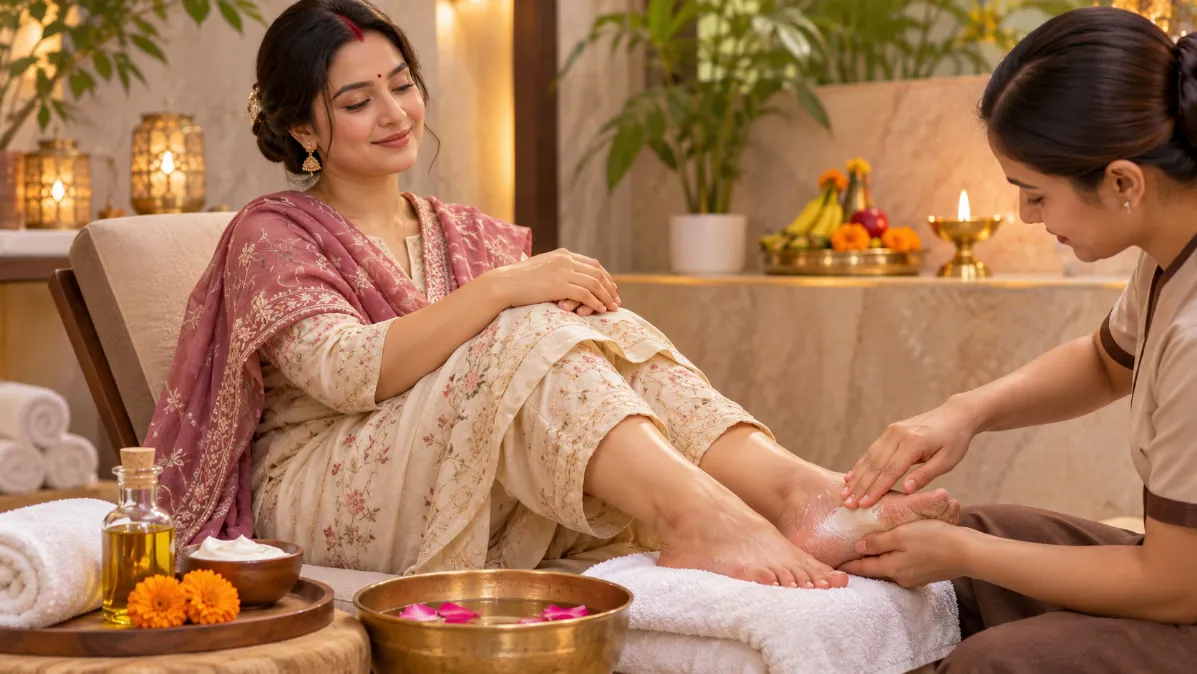
By the time you walk back in from Usha Arghya, your feet have spent hours in cold river water and more hours on wet sand and ghat stone, and the real soreness tends to arrive later, once the skin dries and tightens. Good foot care after Chhath Puja is almost entirely about what you do in the next 72 hours, because the damage Chhath does is specific, and it heals on a specific schedule. What follows is a sequenced protocol, not a list of nice-to-dos.
Why Chhath is harder on feet than most festivals
Most festival foot advice starts with dryness. Chhath begins with the opposite problem: too much water. Standing in a cold river or pond long enough overhydrates the outer layer of your skin until it swells and softens, a state called maceration. Macerated skin looks pale, feels spongy, and wrinkles the way a fingertip does after too long in the bath. The Arghya rituals all but guarantee it: you offer at sunset on Day 3 and again at sunrise on Day 4, and each stretch in the water runs long. Cold water macerates more slowly than warm, but it still sets in somewhere around two to four hours of immersion, and Chhath comfortably clears that threshold.
Soft skin tears where firm skin wouldn't
Maceration goes beyond cosmetic softening. Water works its way down through the epidermis and weakens the skin's shear strength, meaning its ability to resist a sideways drag. A heel that would shrug off a bit of grit on a normal day will split under the same pressure once it is waterlogged.
Sand and stone do the tearing
Now add the walking. Barefoot on the ghat is part of the observance, so every step presses softened soles onto sand and uneven stone. That mechanical load on skin that has lost its armour is what turns maceration into actual micro-cracks, the ones you feel the next morning.
Standing pools blood in your lower legs
The third mechanism has nothing to do with the skin surface. Standing still for hours lets blood and fluid settle in your lower legs, and cold water tightens the vessels at the same time, so the swelling compounds. A 2022 study published in BMC Musculoskeletal Disorders (PMC9685841) found that healthy adults who simply stood through a workday finished with 65 to 81 millilitres more volume in each leg. Chhath asks for more standing hours than that, in colder conditions. The swelling you see is a normal vascular response, not an injury.
The first hour after you get home
Don't go straight to bed, and don't reach for a pumice stone. The first hour sets up everything that follows.
Run a basin at 38 to 40°C, warm enough to feel comforting against the inside of your wrist but nowhere near hot. Soak for 10 to 15 minutes with either a tablespoon of Epsom salt or a teaspoon of mustard oil stirred in. Hot water is the wrong instinct here: it dilates blood vessels and worsens the pooled-blood swelling, and it drives even more moisture into skin that is already overloaded. Warm water relaxes the vessels gently and loosens the day's grit without adding insult.
Drying matters as much as soaking. Press a towel against the skin and lift it away, blotting rather than rubbing. Macerated skin drags and lifts if you scrub it, and a torn flap of soft skin is exactly what you are trying to avoid. Get carefully between the toes, where maceration hides.
Then, while the skin is still barely damp, seal it. Mustard oil, sarso tel, is the traditional post-Chhath choice in many Mithila households, and there is a real reason it works. As an occlusive, it forms a film over the skin that slows transepidermal water loss, trapping moisture inside cracked heels overnight instead of letting it evaporate. A thick petroleum-jelly-based balm does the same job if you prefer it. Apply a visible layer, not a rubbed-in trace: enough that your feet look faintly shiny, then cotton socks over the top.
Day 1: bring the swelling down, protect the cracks
Foot care after Chhath Puja on Day 1 comes down to two jobs: bring the swelling down and keep the cracks protected. Your highest-value move costs nothing. Lie down and raise your feet above the level of your heart for 20 minutes at a stretch, several times through the day. That position lets gravity drain the fluid that standing pushed down, and warmth keeps the vessels open enough to carry it away. Most of the swelling settles within about 24 hours this way. Reach for ice only if one specific spot is hot and throbbing, because cold tightens the very vessels you need open to clear general swelling.
Leave the cracks alone today beyond keeping them oiled. The urge to scrub a rough heel is strong, but the skin is still soft and still macerated, and scrubbing now strips living tissue and deepens the split. Oil, cover, rest with your feet up. That is the whole of Day 1 for the skin itself.
Footwear is the quiet trap. Soft, open house slippers with a cushioned sole are right for the first 24 hours. Going fully barefoot on hard floors presses on tender soles, and any strap that cuts across a crack or a swollen instep will make things worse. Rubber chappals that trap sweat are worth skipping too, since macerated skin does not need more moisture held against it.
Days 2 and 3: rebuild the barrier
By now the swelling should be down and the skin starting to firm up. Gentle exfoliation finally earns its place at this stage, but only after one check.
Press a fingertip into your heel. White, spongy, or wrinkled skin is still macerated; a pumice stone will tear it, so wait. Once the skin has returned to its normal firm texture and colour, a light pass with a pumice or foot file after a short soak lifts the dead, flaked edges without going near living skin. Two or three times across the week, never daily, and never on an open crack.
Cracked heels after Chhath Puja that haven't closed need an overnight wrap. Over clean, dry skin, apply a humectant-plus-occlusive layer: a urea cream, then mustard oil or petroleum jelly on top to lock it in, then cotton socks. Dr. Prarthana Adhikari, a Kathmandu dermatologist, recommends this same approach for persistent cracked heels, noting that moisturizers combining ceramides, natural oils, and urea in the 10 to 15 percent range work best when paired with lukewarm rather than hot water for washing. The humectant draws water into the skin, the occlusive holds it there overnight, and the crack knits from the base up.
A crack has moved past home care when it opens to pink or weeping tissue, stays painful after two or three days of this routine, or shows any redness spreading from its edges. Stop soaking and see someone at that point.
The Anura Spa day-by-day recovery timeline
Seeing how each phase lines up with what your skin is actually doing makes it easier to follow. This is the protocol we walk Chhath observers through at Anura Spa, built from the foot presentations we see each year in the days after the ritual.
- Night of Day 4: Warm soak, careful blot-dry, heavy occlusive, socks. Getting the feet out of the wet and starting the 24 hours of dry exposure that maceration recovery needs as a minimum.
- Day 5: Rest with feet elevated for the swelling, oil for the cracks, soft footwear, no tools. Mild immersion softening resolves in two to three days when the skin is kept dry, so this is a holding-and-protecting day.
- Days 6 to 7: With the skin firmed up, gentle exfoliation and the overnight urea wrap come in. According to skin cell renewal research cited on blister-prevention.com, epidermal cells complete a full cycle in roughly 39 days, which is why nightly heel oiling should continue well past the point the skin looks fine. This window is also when foot reflexology or a pedicure becomes appropriate.
- Day 7 and beyond: Surface healing is usually done, but keep heels oiled nightly for a few weeks to support full barrier renewal.
When to book a pedicure or reflexology after Chhath
Both help, at different times, for different reasons.
Wait at least 48 hours before a pedicure. Maceration compromises the epidermis through its full depth, and a metal tool pressed against skin that weak can tear through it and expose the raw dermis underneath, turning a cosmetic session into an open wound. Two days of dry air let the barrier begin to reform and hold up to tools. Book the pedicure for Day 6 or later, once your heels pass the firmness check.
Foot reflexology follows the opposite logic, which is why it can happen the next day. Pressure works through the intact tissue of the sole without putting any instrument to the skin surface, so the 48-hour tool rule simply doesn't apply. What reflexology reaches is the deep ache in the ball and arch from hours on hard stone, the soreness no cream touches because it sits under the skin, not on it.
For wet-weather foot problems, our monsoon foot care guide covers fungal and wet-shoe issues. Post-trek soreness has its own treatment-first guide, since altitude and boot friction damage feet through a different mechanism than cold-water immersion.
Warning signs beyond normal soreness
Most post-Chhath feet return to normal within a few days. A handful of signs mean you should see a doctor rather than wait out another soak:
- Numbness or tingling that persists past 24 hours. Prolonged cold-water immersion can irritate the nerves, and lingering numbness is worth checking rather than ignoring.
- Swelling that worsens with the legs raised instead of settling, or that stays in only one leg.
- A crack or fissure with spreading redness, warmth, or discharge, which points to infection.
None of these are common, but none of them improve by doing more of what hasn't worked.
Foot care after Chhath Puja: questions people ask
Why do feet swell more after Chhath than after other festivals?
Two things happen at once that don't combine at other festivals: hours of standing, which let fluid pool in your lower legs, alongside prolonged cold-water immersion, which tightens the blood vessels and compounds the pooling. Other observances involve the standing but not the extended cold immersion, so the swelling is milder.
Can I use mustard oil on cracked heels the first night home?
Yes, and the night you return from the ghat is the ideal time. After a warm soak and careful drying, mustard oil acts as an occlusive, sealing moisture into the cracks overnight. Apply a visible layer and cover with cotton socks. The only caveat is to blot the skin dry first, so you are sealing in moisture, not trapped river water.
How long should I wait before booking a pedicure after Chhath Puja?
At least 48 hours. Macerated skin is weakened through its full thickness, and metal pedicure tools used too early can tear it and expose the raw layer beneath. Giving it two days of dry air lets the barrier reform enough to handle the tools safely.
Is numbness or tingling normal after standing in cold water?
Briefly, yes, even after hours in a cold river. Cold slows nerve conduction, and some numbness as your feet rewarm is expected. Numbness or tingling that lasts beyond 24 hours is different: it can signal nerve irritation from the immersion and is worth having a doctor check.
Macerated skin vs. cracked skin: does it change treatment?
It changes everything about the first two days. Macerated skin is soft, pale, waterlogged, and over-moisturized; it needs drying out and protecting, not scrubbing or more soaking. Cracked skin is split and often dry at the edges; it needs humectant plus occlusive and time. Right after Chhath, your skin is usually macerated first, which is exactly why exfoliation and pedicures have to wait until it firms up.
The hand-off in foot care after Chhath Puja is simple: home care carries you through the first two days, and once the acute soreness settles, a professional pedicure or foot reflexology session clears the last of the tightness and cracked skin faster than home care alone. Read through both treatments to decide which one fits the stage your feet are at.