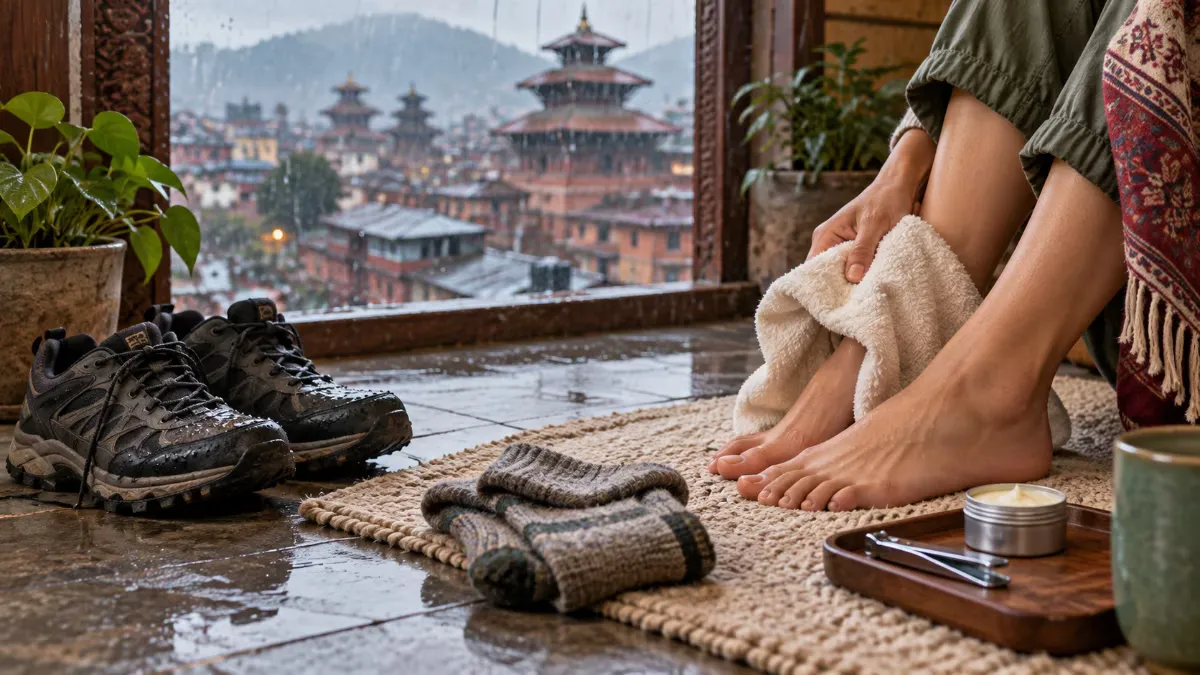
By the second week of the rains, most Kathmandu commuters have already walked home in soaked shoes a dozen times over. That is enough. Nepal's monsoon concentrates most of the country's rainfall between June and September, and warm, damp shoes create exactly the kind of environment in which the fungi behind athlete's foot thrive. The version of monsoon foot care Nepal residents actually need starts with one idea: feet get infected because they stay wet for too long, not because a spa day was skipped.
What Kathmandu's Monsoon Does to Your Feet in the First Week
The rains do not damage feet slowly. Moisture builds up through repeated wet commutes, damp socks, and shoes that go back on before they have properly dried. Knowing that pattern is what separates a manageable season from months of avoidable itching and irritation.
Humidity, wet shoes, and the conditions that help fungi thrive
Nepal's monsoon runs from June to September and accounts for about 80% of the country's rainfall, according to the Nepal Tourism Board. Feet do not need to be submerged to be at risk. A shoe that stays damp keeps the skin between your toes wet and softened, while the fungi that cause athlete's foot thrive in warm, moist environments. Put plainly, the risk builds when damp shoes and socks stay against the skin or are worn again before they have fully dried.
Athlete's foot vs. nail fungus: how to tell them apart
Two different problems get lumped together every rainy season, and they call for different responses. Tinea pedis, or athlete's foot, often affects the skin between the toes and may cause itching, burning, peeling, cracking, or softened skin. Onychomycosis, nail fungus, affects the nail itself and can make it discoloured, thickened, brittle, or crumbly. Trouble mainly on the skin between the toes is more consistent with athlete's foot. Persistent thickening or discolouration of the nail can suggest nail fungus, although other nail conditions can look similar and may need a proper diagnosis.
Step 1: Stop Your Footwear From Becoming the Problem
Your feet are only as dry as your shoes let them be. In Kathmandu's wet season, footwear is one of the biggest variables you can control.
Drying wet shoes in monsoon humidity: what actually works overnight
Most guides cheerfully tell you to air-dry your shoes overnight. During humid monsoon weather, that may not be enough, especially with thick linings or closed footwear. Speed the process up instead. Remove the insoles where possible, stuff wet shoes with crumpled newspaper to draw out moisture, and replace the paper once it becomes damp. Silica gel packets can help absorb residual moisture, and a fan aimed toward the shoe openings improves airflow. Avoid sealing damp shoes in a cupboard or plastic bag, where moisture has nowhere to go.
The two-pair rotation rule that prevents moisture buildup
One pair of shoes may not dry fully overnight during the monsoon, which is the whole case for owning two. Rotate them so each pair gets about 24 hours, or longer where possible, to dry between wears. Wear one today, dry the other, switch tomorrow. It is a dull habit, but keeping footwear dry is one of the simplest ways to reduce the conditions that favour athlete's foot.
Step 2: A Daily Cleaning Habit That Blocks Infection at the Source
Washing between toes: the step most Kathmandu residents skip
Wash your feet daily, and then do the step almost everyone skips: dry between every toe, one by one, until the skin there is genuinely dry and not just quickly patted. For prevention, this matters more than adding another product to the shelf. The spaces between your toes hold moisture and see less airflow, which is one reason athlete's foot commonly appears there. Once symptoms have already started, however, drying supports treatment; it does not replace an appropriate antifungal.
Antifungals: when over-the-counter care stops being enough
If itching, peeling, or scaling has already started and athlete's foot seems likely, a pharmacist can recommend an over-the-counter topical antifungal such as clotrimazole, tolnaftate, or terbinafine where appropriate. The dose and treatment length depend on the product, so follow the label or a pharmacist's directions and complete the recommended course even if symptoms improve early. If the rash is worsening, keeps returning, or is not improving with appropriate treatment, see a doctor or dermatologist. One important limit: antifungal creams made for skin do not treat fungus inside the nail. Suspected nail fungus may need prescription topical or oral treatment after the diagnosis is confirmed.
Step 3: Adjust Your Nail Routine for the Wet Season
How to trim without encouraging ingrown edges
After a long rainy walk or soak, let your toenails dry before trimming so they are easier to cut cleanly. Cut straight across rather than rounding deeply into the corners, and do not cut them excessively short. That simple technique helps reduce the chance of the nail edge growing into the surrounding skin.
Three early signs that deserve a closer look
Monsoon staining and early nail fungus can look similar at a glance, so watch for structural change rather than colour alone. Three common warning signs are thickening of the nail plate, brittleness or crumbling at the edge, and persistent yellow, white, or brown discolouration. These changes can also have causes other than fungus, so a nail that keeps changing structure is a reason to seek medical assessment rather than filing it aggressively or relying on a skin cream.
Step 4: Use Professional Treatments at the Right Point in Your Routine
By now the daily routine is carrying most of the load, and there is a point where a professional treatment adds something your bathroom cannot. Here is the honest comparison.
Factor | Daily DIY routine | Pedicure or reflexology at a spa |
Effort | Around five minutes, once or twice a day | One booked session |
Cost | Near zero | Per visit |
What it does | Keeps feet clean and dry; reduces moisture buildup | Grooming, callus care, relaxation, and foot comfort |
When it fits | Every day of the wet season | When skin is intact and there is no active infection |
Neither replaces the other. The professional session sits on top of the daily habit, at the right moment.
The one rule before booking a monsoon pedicure in Kathmandu
Before you book anything, one rule matters: do not have a pedicure or foot spa over open, cracked, inflamed, or visibly infected skin. A pedicure is a grooming and maintenance treatment, not a treatment for fungal infection. Address the infection first, then book once the skin is healthy and intact. Hygiene matters as well: tools and equipment should be properly cleaned between clients, and cuticles should not be aggressively cut. If you are unsure what a pedicure session involves, the Anura Spa pedicure guide walks through the process step by step.
What reflexology adds that a pedicure does not
A pedicure focuses on the surface: nails, hard skin, and grooming. Foot reflexology uses pressure on the feet and fits better when the goal is relaxation and comfort after long, wet-weather commuting days. It may feel soothing for tired feet, but it should not be treated as a medical fix for circulation problems, lymphatic drainage, swelling, or infection. If swelling is persistent, unusual, one-sided, painful, hot, or red, medical evaluation is the better next step.
When the Routine Stops Working: Five Signs That Need a Doctor
A consistent routine handles a lot of monsoon foot trouble. These signs suggest that the problem has moved past simple home care and deserves medical assessment.
Itching, peeling, or scaling that is worsening or is not improving after an appropriate course of over-the-counter treatment.
A nail that stays thickened, crumbly, or discoloured, especially when the cause is uncertain.
A rash that is spreading, increasingly painful, hot, or red.
Open sores, pus, significant cracking, or other signs of secondary infection.
Any suspected foot infection if you have diabetes, poor circulation, or a weakened immune system.
Do not wait for several signs to appear at once. Open sores, pus, rapidly spreading redness, significant pain, fever, or infection in someone with higher medical risk should be assessed promptly.
Monsoon Foot Care in Nepal: Common Questions Answered
How often should I get a pedicure during Nepal's monsoon season?
For routine grooming, every three to four weeks is a reasonable schedule for many people, provided the skin is healthy and intact. The monsoon itself does not demand more frequent pedicures. Consistent daily washing, thorough drying, clean socks, and dry footwear matter more between visits.
Can I book a pedicure if I already have a fungal infection?
No. Postpone a pedicure or foot spa if you have an active fungal infection, open cracks, sores, or inflamed skin. Get the problem assessed and treated first, then return to salon care once the skin is healthy and intact.
What is the fastest way to dry wet shoes in Kathmandu's monsoon?
Remove the insoles where possible, stuff the shoes with crumpled newspaper, replace the paper once it becomes damp, and use a fan to improve airflow into the openings. Silica gel packets can help with residual moisture. During humid weather, passive air-drying may leave thicker shoes damp by morning, so giving them more time and rotating between two pairs is the safer routine.
Does reflexology help with wet-weather leg heaviness and swelling?
Foot reflexology can be relaxing and may feel soothing for tired feet after long days of walking or commuting, but it is not an established treatment for circulation problems, lymphatic drainage, or unexplained swelling. Persistent, painful, one-sided, hot, or red swelling should be medically assessed rather than managed with a spa treatment.
Which antifungal ingredient should I look for during the rainy season?
Common over-the-counter options for athlete's foot include clotrimazole, tolnaftate, and terbinafine. Follow the product label or a pharmacist's advice because treatment schedules vary by formulation. If the nail itself is thickened, crumbly, or discoloured, do not rely on an athlete's-foot cream to clear it; nail fungus may need confirmation and prescription treatment from a healthcare professional.
Monsoon foot care is mainly about controlling moisture day after day. Keep feet clean, dry your shoes properly, and treat suspected infection before it becomes a salon problem. Once the skin is healthy and intact, an Anura Spa pedicure or foot reflexology session can fit back into the routine for grooming, relaxation, and comfort.