
Yes, you can usually do a facial and body scrub on the same day, provided your skin is not already irritated and both treatments suit your skin type. At home, one simple sequence is to exfoliate the face gently before showering, then use a separate body scrub in warm water. Face first is a convenient routine, though not a universal safety requirement. Most guides cover how often to exfoliate each zone separately. Almost none answer what to do when you want both in a single session.
The reasoning becomes clear once you separate the products from the order. Facial skin can be more reactive than tougher body areas, so gentle technique, suitable products and avoiding too much exfoliation matter more than which area you treat first. A professional facial is also more than a scrub: it may include cleansing, massage, masks and other steps tailored to your skin.
Yes, You Can Do Both: The Method Matters More Than the Order
Same-day exfoliation can suit many skin types. What keeps it comfortable is gentle technique and not overdoing either step, rather than the length of any gap between them. Two patterns work well: a facial scrub in the morning and a body scrub that evening, or both in a single session with the face before the shower as a practical option. If waxing is also on your list, the timing shifts again, and pre- and post-wax precautions deserve separate attention.
Why a gentle sequence protects your skin barrier
Exfoliation removes dead cells from the surface, but too much rubbing can irritate the skin barrier: the outer layer that holds moisture in and helps keep irritants out. Treating the face first can make it easier to give that delicate area your full attention, then move to the body with a different product. The order itself does not make an unsuitable scrub safe. As the American Academy of Dermatology advises, the method and frequency should match your skin type.
The one rule that helps prevent same-day over-exfoliation
Keep products matched to the area they are designed to treat. A coarse body scrub should not go on your face unless it is specifically formulated and labelled for facial use. Likewise, facial exfoliants are not automatically suitable for tougher areas such as heels. Separate products, light pressure and an appropriate frequency are better safeguards than a rigid face-versus-body rule.
Why Facial Skin Needs a Different Scrub
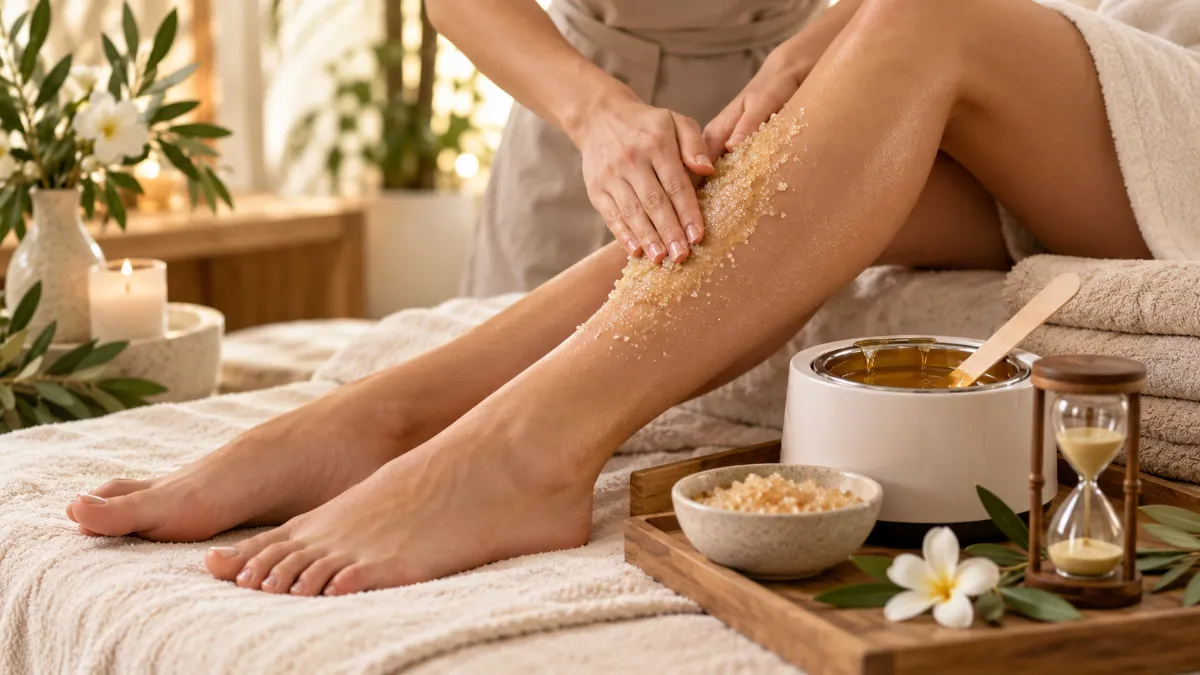
Rub a gritty body scrub between your fingers: sugar, salt or other particles may suit some rough body areas but feel too abrasive for the face.
Skin thickness and particle size: the practical difference
Here is a measurement worth putting into context. A 2023 study in Skin Research and Technology measured 99 adults and reported mean facial epidermal thicknesses of about 0.325 to 0.402 mm across the sites studied, with mean total facial skin thicknesses of about 1.31 to 1.67 mm. The published study did not compare every body area or establish a safe scrub-particle size. Skin thickness varies greatly across the body, too: heels are not the same as the chest or inner arms.
Those differences explain why product design matters. Facial exfoliants often use gentler particles or non-scrub approaches, while some body scrubs are formulated for rougher patches. Neither the size of a grain nor the label alone guarantees that a product is right for every skin type.
What happens when coarse body scrub meets delicate facial skin
On reactive facial skin, coarse particles and heavy pressure can cause redness, stinging and irritation. Repeated rubbing may weaken the skin barrier and leave the surface feeling dry or unusually sensitive. That is why a body scrub is not a shortcut for a facial exfoliant.
Step 1: Apply Your Facial Scrub Before the Shower
For this home routine, begin on freshly cleansed skin, before stepping into the shower. If your facial product calls for damp skin or a different order, follow those instructions instead.
How to work it in without irritating the skin barrier
Keep the skin dry or lightly dampened, whichever your product specifies. Work the scrub in with your fingertips using small, light circles for around 30 seconds, or according to the label. Pressure is not what makes a routine better. Rinse with lukewarm water and pat, rather than rub, the skin dry. Skip physical scrubbing altogether if it routinely makes your skin sting or flare.
What to skip immediately after rinsing your face
For the rest of the day, keep the routine simple if your skin feels sensitive. Retinoids, AHAs, BHAs, benzoyl peroxide and some stronger vitamin C formulations may add irritation; vitamin C itself is not an exfoliating acid. A plain, fragrance-free moisturiser is a sensible finish. Resume other products once your skin feels comfortable, rather than following a fixed timetable regardless of its response.
Step 2: Do the Body Scrub in Warm Water
Step into a warm shower, not a hot one, and let water run over you briefly before reaching for the scrub. Warm water can make the routine more comfortable, but do not soak for so long that your skin dries out. Apply the product as directed and use gentle movements rather than vigorous rubbing.
Which body zones benefit most from scrubbing
Pay attention to the areas that commonly feel rough: elbows, knees, heels and the backs of the upper arms. These zones may benefit from targeted care, but they do not need aggressive pressure. Take extra care around cracked heels, inflamed bumps or any broken skin.
Where to ease off the pressure even on your body
Thin or easily irritated areas exist below the neck too. Across the chest, inner arms and stomach, use especially light pressure or avoid the scrub if the skin is sensitive. A body scrub should leave you comfortable, not raw.
After Both Scrubs: What Your Skin Needs Next
Pat yourself dry until your skin is just damp, then apply moisturiser promptly while the surface still holds some water.
Moisturising face and body with separate products
A facial moisturiser on the face and a lotion or cream on the body can be a practical combination because each may address different needs. Still, one gentle, suitable moisturiser can sometimes work for both areas; separate jars are not a safety requirement. For a broader look at how each zone is treated in a full beauty session, the treatment menu shows AnuraSPA's available services.
Why freshly exfoliated skin needs SPF before you go outside
Sun protection matters every day, including after exfoliation. Before heading outdoors, apply broad-spectrum SPF 30 or higher to your face and other exposed skin, and use shade or protective clothing as needed. Certain chemical exfoliants, including AHAs, can increase sun sensitivity; a gentle physical scrub does not automatically create a fixed 24-to-48-hour period of extra UV exposure. The FDA's guidance on AHAs makes that distinction especially important.
Signs You Have Pushed Your Skin Too Far in One Session
For a combined at-home routine, once a week or less is a cautious starting point for people who tolerate gentle exfoliation, not a target everyone needs to reach. Sensitive or reactive skin may need much less, or no physical scrub at all. Professional treatments follow a different schedule: AnuraSPA's body scrub service generally recommends a session every three to four weeks, adjusted to your skin.
How to tell normal sensitivity from real over-exfoliation
A little temporary pinkness may settle quickly, but persistent redness, stinging when moisturiser goes on, flaking or a tight, shiny surface suggests irritation. When your usual cream burns on contact, stop scrubbing and give the skin time to recover. Do not treat discomfort as proof that a scrub is working.
What to leave out of your routine for the next 48 hours
If you have irritated your skin, pause exfoliation and strong actives for at least the next couple of days, and longer if symptoms continue. Stick to a gentle cleanser, a fragrance-free moisturiser and daily sun protection. Avoid exfoliating sunburned or broken skin, and be especially cautious with eczema, rosacea or active irritation. If burning, swelling or redness is significant or does not improve, seek advice from a dermatologist.
How a Spa Therapist May Sequence Both Treatments
In a treatment room, a back-to-back booking does not have one compulsory order. The facial and body scrub may be arranged around cleansing, rinsing, product choice and the guest's skin needs. A professional facial can also include optional steam before gentle exfoliation, as explained in the guide on whether steam comes before or after a facial.
Map a professional session against a home routine, and the useful principles still align. Exfoliate gently, choose an appropriate product for each area, avoid irritated skin, moisturise afterwards and finish with sun protection. At home, face first can be a neat way to organise both steps; at a spa, let the therapist tailor the sequence to the actual treatments. Treat a facial and body scrub on the same day as a reason to assess the total exfoliation your skin receives, not an invitation to double the intensity.
Common Questions About Facial and Body Scrub Same Day
Should you use the same scrub product on your face and body?
Usually not. A coarse body scrub may be too abrasive for facial skin, while a gentle facial scrub may not be the best choice for rough heels or elbows. Use the product only on the areas its label recommends, unless it is clearly formulated for both.
How long should you wait between a facial scrub and a body scrub?
There is no universal waiting period when you are treating separate areas and your skin tolerates both products. You can scrub the face gently before the shower and the body under warm water minutes later, or separate them into morning and evening. Comfortable technique matters more than the clock.
Can you do a facial and body scrub same day with sensitive skin?
Sometimes, but it depends on what makes your skin sensitive. Avoid physical scrubs if they trigger burning, flares or persistent redness; a gentler method or skipping exfoliation may be better. Do not exfoliate over broken, sunburned or actively inflamed skin. If you are unsure, ask a dermatologist or tell your spa therapist about your skin concerns before booking.
How often can you exfoliate face and body on the same day?
There is no frequency that suits everyone. For people who tolerate gentle home scrubs, once a week or less can be a starting point; sensitive skin may need longer gaps or no scrub. AnuraSPA suggests roughly three to four weeks between professional body scrub treatments, based on skin needs. Let the response of your skin, not a calendar rule, decide when to repeat.
Does the facial or body scrub come first at a spa booking?
Either may come first. A spa therapist should choose the order according to the treatments, shower or rinse steps, and your skin's condition. A home face-first routine is one option, not a rule that every professional facial-and-body booking must follow.
To explore how these treatments can work together in a professional session, visit AnuraSPA's facial and body scrub pages and ask the therapist which sequence suits your skin.