Search “steam before or after facial” and nearly every result answers a single question: cleanse first, or steam first? That one decision matters, but it is not the only one. A complete facial makes four sequencing calls, and the pages competing for this search each cover only a fragment. The short version: steam after you cleanse, before you exfoliate or mask, and always before serum and moisturizer. Below is the full order, the physiological reason each step sits where it does, and how to adjust for your skin type.
Why Steaming Out of Order Undercuts the Whole Facial
Steam is a primer, not a treatment on its own. It warms and hydrates the outermost layer of skin, helping soften surface debris and sebum so the steps that follow can be done more gently. That softened state is temporary, so exfoliation and a clay mask are usually placed after steam rather than before it.
Put steam in the wrong slot and you lose much of that practical benefit. Steam before cleansing means warm vapour is acting on makeup, sunscreen, and the day’s oil instead of clean skin. Steam after your mask adds heat after the treatment step has already done its work. Sequence is the difference between using steam as preparation and simply adding extra heat to the routine.
One myth worth retiring first: steam does not “open” your pores like a door. Pores have no muscles. Heat increases blood flow at the skin surface and can soften oil and debris around follicles, which can make cleansing and other gentle treatment steps easier without literally opening or closing pores.
The Full Facial Order, Step by Step
Here is the sequence a professional follows, and the one to copy at home.
Step 1: Cleanse to clear the surface first
Strip off makeup, sunscreen, and the day’s oil before anything else touches your face. Steam works best as a prep step on clean skin rather than over a coated surface.
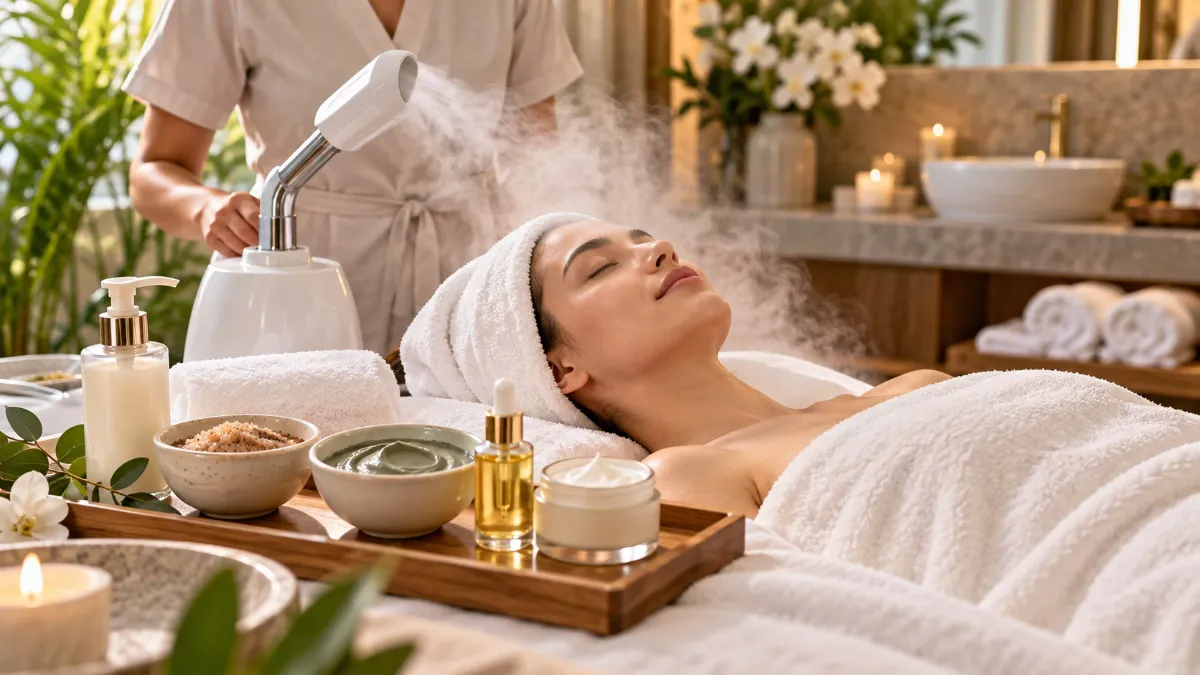
Step 2: Steam 5 to 10 minutes on clean skin
Keep the steam comfortably warm, never painfully hot. If you use a bowl, stay roughly 25 to 30 cm away and avoid freshly boiled water; with a facial steamer, follow the manufacturer’s distance guidance. Up to about ten minutes may suit normal or oily skin, while sensitive or dry skin should keep the session shorter or skip direct steam if it causes redness or irritation.
Step 3: Exfoliate while skin is warm and softened
This is the window. Warm, hydrated skin may feel softer, so a gentle exfoliant can often be used with less pressure than aggressive scrubbing on dry, cool skin. Keep the exfoliation light, especially if the skin is already warm or flushed.
Step 4: Mask after steam
If steaming is part of your routine, masks generally follow it. Clay or charcoal can go on once steaming ends and the skin feels comfortable. If you are using a hydrating, sheet, enzyme, or brightening mask, let any obvious heat or flushing settle first and follow that product’s directions.
Step 5: Toner if you use one, then serum and moisturizer
Toner is optional and its role depends on the formula; it is not a required step for “resetting” skin pH. If you use one, apply it after the treatment steps, followed by serum and moisturizer. Finishing this way leaves leave-on products on clean skin without exposing them to another round of steam or exfoliation.
Steam Before or After Cleansing: Why the Order Isn’t Optional
Cleanse first. Sunscreen, makeup, and the day’s sebum sit on the skin as a surface film. Removing that layer first gives steam clean skin to work on and avoids adding heat over residue that you were going to wash away anyway.
Cleveland Clinic likewise recommends washing your face with a gentle cleanser before steaming. Cleanse, pat the skin dry, then steam only as long as your skin remains comfortable.
Steam Before or After Exfoliation: The Timing That Prevents Irritation
For a gentle at-home routine, exfoliate after steam rather than adding steam to freshly scrubbed skin. At least one popular guide tells you to scrub first; in practice, putting heat on already exfoliated skin can simply add another source of irritation.
The practical reason is straightforward. Warm vapour raises your skin’s surface temperature and increases blood flow at the surface. The added warmth and moisture can temporarily soften the outer layer of skin, so gentle exfoliation may require less rubbing. The key word is gentle: if the skin already feels hot, tight, or irritated, skip exfoliation rather than stacking more stimulation on top of steam.
One firm caution: keep potentially irritating actives away from a hot, freshly steamed routine unless the product directions specifically support that use. Ingredients such as benzoyl peroxide, salicylic acid, retinoids, and stronger exfoliating acids can already cause dryness or irritation; adding heat may make sensitive skin less tolerant. When in doubt, use them at a different time.
Steam Before or After a Face Mask: The Answer Changes by Mask Type
If you are using steam as part of the facial, the mask comes afterward. What “after” means in practice depends on the mask and how your skin responds to heat.
Clay and charcoal: apply after steam, once skin feels comfortable
Clay and charcoal masks are designed to absorb excess surface oil, so they fit naturally after cleansing and optional steaming. A 2023 study of a kaolin- and bentonite-containing clay mask found a 68.97% immediate reduction in measured skin oiliness and a 65.77% reduction in open comedones after four weeks of twice-weekly use. The study evaluated the mask itself, not whether steaming beforehand improved its effects, so the evidence supports the clay mask—not a claim that steam makes it work better.
Sheet and hydrating masks: let visible heat settle first
If your skin is still noticeably hot or flushed after steaming, give it a brief chance to settle before applying a sheet or hydrating mask. There is no need to race the clock; comfort is a better guide than an exact one- or two-minute rule.
Enzyme and brightening masks: keep the steam conservative
Enzyme and brightening masks can contain ingredients that are more stimulating on freshly heated skin. Follow the mask manufacturer’s directions and keep steam conservative if you plan to use an active treatment afterward. If the skin is already red or sensitive, skip the extra heat.
Skin-Type Steam Sequence Matrix
Duration, frequency, and the right next step all shift with your skin. Use this table as a practical starting point and adjust downward if heat causes persistent redness, stinging, or dryness.
Skin type | Steam duration | Frequency | Next step after steam | Mask that fits |
Oily / congested | 5–10 min | 2–3x per week | Gentle exfoliation; avoid forceful extraction | Clay or charcoal |
Combination | 5–7 min | 1–2x per week | Gentle exfoliation on T-zone only | Balancing mask; clay on T-zone only |
Dry / dehydrated | 3–5 min | About 1x per week | Skip the physical scrub | Hydrating or cream mask |
Sensitive / redness-prone | Warm towel or skip direct steam | Rarely, if at all | No exfoliation if skin is reactive | Barrier-supportive mask |
Those frequency ranges align with commonly cited dermatology guidance: less-sensitive or oily skin may tolerate steaming two to three times a week, while drier skin often does better around once a week. Combination skin sits in the middle: steam briefly, then treat the oily and dry zones differently in the steps that follow.
The sensitive row is the one to respect most. Cleveland Clinic advises caution for people prone to rosacea, visible redness, broken capillaries, eczema, or very sensitive skin because heat can aggravate flushing and inflammatory skin conditions. A warm, damp towel may be a gentler alternative for some people, but skip heat entirely if it triggers symptoms.
Professional Spa Steam vs. At-Home Steam
The sequence rule for steam before or after facial treatments is broadly the same in a treatment room and at home. Three things differ, and all three come down to control.
First, water and equipment. Professional facial steamers are designed to deliver a consistent output, and many manufacturers specify distilled or demineralized water to reduce mineral buildup in the machine. At home, follow the steamer manufacturer’s instructions rather than assuming any water source is interchangeable. For broader steam-room guidance, see Anura Spa’s steam bath guide.
Second, distance and heat. A professional can control nozzle distance and output more consistently. At home, avoid painfully hot steam and do not hover over freshly boiled water. Heat should feel comfortably warm; increase your distance or stop if you experience stinging, burning, or persistent redness. Research on skin-barrier responses to hot water and heat also supports being conservative: hotter exposure can increase redness and transepidermal water loss.
Third, judgment. The biggest thing a professional controls is the decision to skip steam entirely. Faced with a compromised barrier or an active flare, an esthetician can read the skin in real time and switch to a gentler step. At home, that call is yours to make honestly.
Steam Routine Questions a Facialist Hears Every Session
Should you wash your face before or after steaming it?
Before. Cleanse first so steam acts on clean skin rather than over makeup, sunscreen, excess oil, and surface debris. A quick rinse afterward is optional if you feel sweaty, but it is not required for everyone.
How long should you steam before applying a clay mask?
Up to about five to ten minutes may suit normal or oily skin if it remains comfortable. Apply the clay mask after steaming once the skin is no longer uncomfortably hot. If your skin becomes red, stings, or feels tight, stop earlier and skip the mask if necessary.
Can you use a face mask effectively without steaming first?
Yes. Masks work on clean, unsteamed skin. Steam is optional; it can soften surface oil and make the skin feel more prepared for the next step, but a mask does not depend on steaming to work.
Does steaming before exfoliation cause more irritation on sensitive skin?
It can. Steam plus exfoliation is a significant amount of stimulation for reactive skin. Sensitive types should keep heat mild, consider skipping direct steam, and exfoliate rarely and gently if at all. People with rosacea, eczema, broken capillaries, or persistent redness should be especially cautious.
Is the steam sequence at a professional spa different from what you do at home?
The typical order is similar: cleanse, optional steam, appropriate exfoliation, mask, then finish with leave-on skincare such as serum and moisturizer. What differs is control: professional equipment, steadier distance and heat, and an esthetician’s judgment about when to shorten or skip steam altogether.
Explore the facial and steam bath treatments at Anura Spa to experience a professionally sequenced session, or read the steam bath guide for a closer look at what steam does for your skin and body.