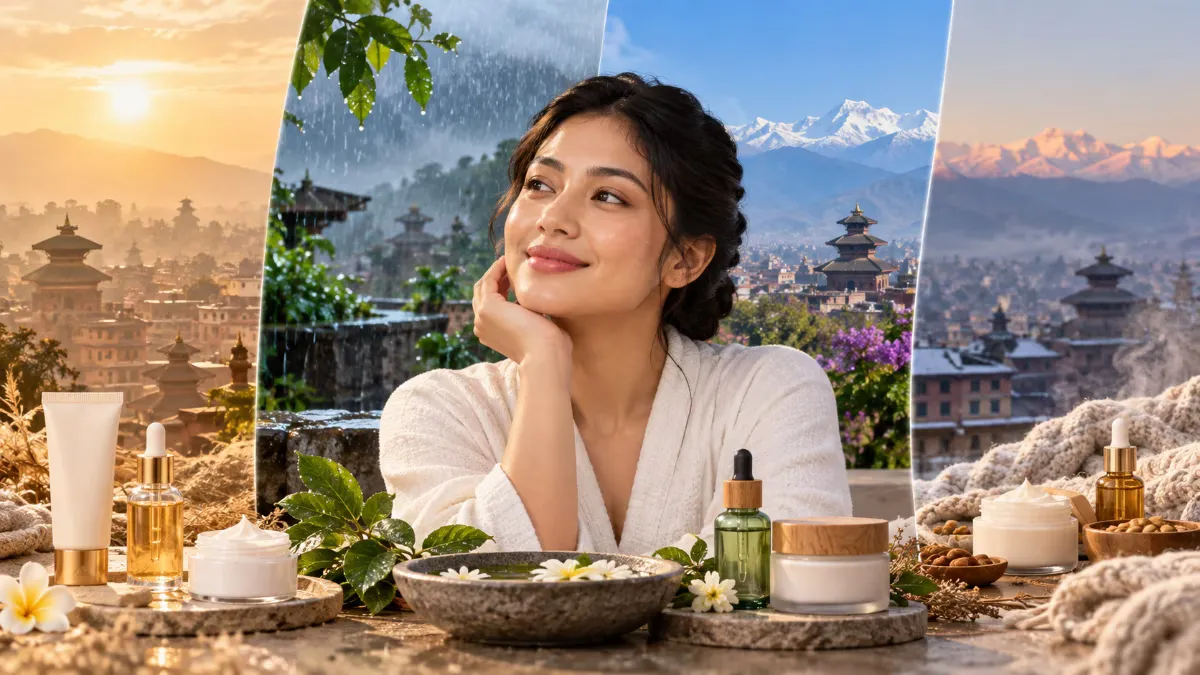
Skincare in Kathmandu is really four routines wearing one calendar. The valley does not drift gently between seasons. It swings from Extreme ultraviolet exposure to saturated monsoon humidity to winter air that can become severely polluted, often inside a few weeks. A moisturiser that rescues your face in January will clog it by August. So the useful question is never "what products are good," but "good for which month," and that is what this guide answers: match what you do to your skin to what the sky is actually doing over the valley.
Why Kathmandu's climate is unusually hard on skin
The valley hands your skin two problems most cities split between very different climates: stronger ultraviolet exposure at altitude and a bowl-shaped valley that can trap pollution. Very few places load both onto the same face at once.
What 1,400m altitude does to UV and seasonal dryness
Kathmandu sits at roughly 1,400 metres, and that figure is not cosmetic trivia. The World Health Organization notes that UV levels increase by roughly 10 percent per 1,000 metres of altitude; its Global Solar UV Index guidance gives a range of about 10 to 12 percent. At Kathmandu's elevation, that works out to roughly 14 to 17 percent more ultraviolet than at sea level under otherwise comparable conditions. That is before you account for how high the sun actually climbs here.
Month | Typical monthly maximum UV index | Category |
|---|---|---|
January | 5 | Moderate |
February | 7 | High |
March | 9 | Very High |
April | 11 | Extreme |
May | 11 | Extreme |
June | 13 | Extreme |
July | 14 | Extreme (peak) |
August | 13 | Extreme |
September | 12 | Extreme |
October | 10 | Very High |
November | 7 | High |
December | 5 | Moderate |
Read that table once, and every seasonal recommendation below stops being impressionistic. At UVI 11 and above, unprotected skin can burn quickly, and Kathmandu reaches Extreme UV levels through much of the April-to-September stretch. The dry-season air can also increase skin dryness and barrier stress, while the elevation adds an extra UV burden.
How the valley's pollution cycle disrupts the barrier
Kathmandu's 2024 annual average PM2.5 was 45.1 µg/m³, roughly nine times the WHO annual guideline of 5. Fine particulate does not just powder the surface and rinse away. It can contribute to oxidative stress and barrier disruption, which may show up as dullness, uneven tone, or skin that suddenly stings at a serum it tolerated last month.
The timing is the cruel part. Pollution peaks in the dry months, not the wet ones, so the particulate load is highest precisely when the air is also stripping moisture fastest.
Pre-monsoon (March to May): peak UV meets valley dust
Why the UV index and dust haze peak in the same window
On 8 March 2026, Kathmandu ranked as the most polluted major city in the world, with an AQI above 200 after a prolonged stretch of unhealthy air. That same March-to-May window carries the UV index from 9 in March to 11 (Extreme) across April and May. From roughly mid-March to late May, the barrier can face particulate stress and intense UV on the same day. It is the one season where both pressures climb together.
Most advice treats UV and pollution as separate stories, one a summer problem, the other a winter one. In Kathmandu they arrive as a single compound assault.
Routine shifts: SPF 50+, antioxidants, light hydration
The answer is short: SPF 50+ broad spectrum every morning, reapplied, because a single application does not survive a day outdoors at UVI 11. A vitamin C or similar antioxidant serum earns its place by doing double duty, mopping up free radicals from both ultraviolet and particulate load. Keep the rest light. Pre-monsoon heat does not want a heavy occlusive layer, so hydrate with a thin humectant and let the sunscreen be the workhorse.
For a full overview of how each product category fits into a Kathmandu routine, the essential skin care guide covers the fundamentals.
Best professional treatment to book before the rains arrive
Book a gentle, barrier-respecting facial in late April or early May, before peak monsoon heat and humidity arrive. Think calm hydration and light decongestion rather than aggressive acids if the skin is already stressed from the UV-and-dust squeeze. Treat it as the tune-up before the long, sweaty stretch ahead.
Monsoon (June to September): humid air, thirsty skin
How sweat and high humidity disrupt the barrier
Humidity registers as hydration on a weather app and can feel like the opposite on your skin. Through Kathmandu's monsoon, prolonged humidity slows sweat evaporation, so sweat can sit on the skin and mix with sunscreen and sebum. For some people, that means more congestion, irritation, and a heavier feel from products that worked perfectly well in the dry season.
That gradient also means monsoon is not one flat block. A gel moisturiser that behaves in June can feel like cling film by August, so the practical move is to lighten textures again mid-season rather than set one monsoon routine and forget it. And feet face their own set of monsoon challenges, covered separately in the monsoon foot care guide.
When monsoon bumps may not be ordinary acne
Warm, humid weather, heavy sweating, and occlusive products can increase the risk of Malassezia folliculitis, often casually called "fungal acne." It tends to appear as small, uniform, often itchy bumps, and unlike ordinary acne it typically does not produce blackheads or whiteheads. If that pattern shows up, do not keep treating it as clogged pores or keep adding acne actives. Keep the routine light and non-occlusive, and consider a dermatologist if the bumps are persistent, itchy, or spreading, because confirmed Malassezia folliculitis is treated differently from acne vulgaris.
That distinction matters because something that looks like a monsoon breakout may need a different approach from ordinary acne.
When to book a deep-cleanse facial and when to wait
A deep-cleanse or decongesting facial can make sense in the thick of monsoon, especially when the problem is blackheads, clogged pores, or ordinary comedonal congestion that may benefit from professional extraction. Uniform itchy bumps without blackheads are different; extraction is not a treatment for suspected Malassezia folliculitis. If the skin is irritated, also be cautious with aggressive exfoliating or brightening treatments while UV remains Extreme. When you do return to brightening treatments, the facial treatment guide explains what to expect and how to prepare.
Post-monsoon (October to November): the best reset window
Why falling pollution and UV make this the exfoliation window
Two pressures often ease together in autumn. UV slides from 10 (Very High) in October to 7 (High) in November, while the end of the monsoon often brings clearer air than the dry pollution season that follows. That can make post-monsoon a practical time for carefully chosen exfoliating or brightening treatments, but the UV is still high enough that sunscreen remains non-negotiable.
Think of this as a practical AHA window rather than a free pass. The FDA notes that alpha hydroxy acids can increase sun sensitivity, so the advantage of autumn is simply that the seasonal UV trend is moving downward, not that sun protection can relax.
Brightening and repair treatments that hold when the air clears
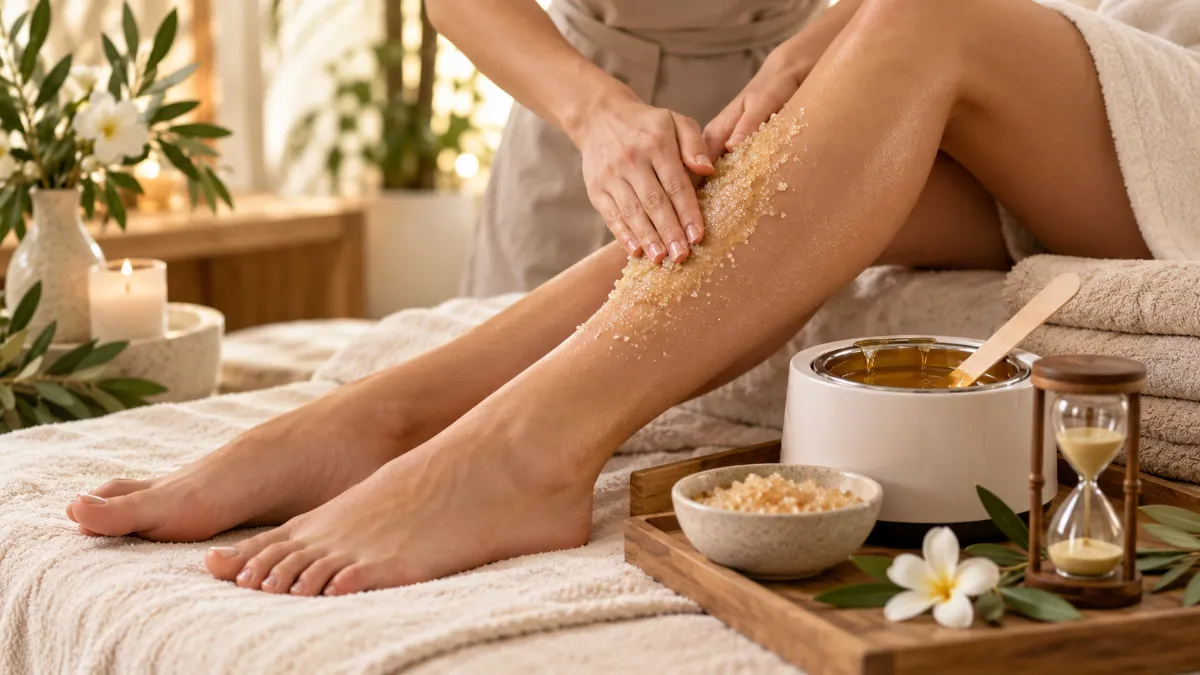
This is the season to make use of the calmer transition. Glycolic or lactic acid exfoliation, brightening facials aimed at the pigmentation and dullness that built up through the UV-heavy months, and a full-body scrub can all fit here when the skin is healthy enough for them. The point is not that autumn guarantees longer-lasting results, but that lower seasonal UV and clearer post-monsoon conditions can make recovery and maintenance easier than during peak pre-monsoon exposure.
Winter (December to February): dry cold and trapped pollution
The dual threat of dry cold and trapped PM2.5
In early December 2025, PM2.5 at valley monitoring stations hit 168 to 199 µg/m³ in a single day: Jadibuti at 199, Jawalakhel at 182, and Teku at 172.
The geography helps explain the scale. Cold winter conditions and slower air movement can trap pollution close to the ground in Kathmandu's bowl-shaped valley. ICIMOD's analysis found that December 2025's cleaner spell was most likely linked to reduced emissions rather than meteorology alone, while the broader pollution load reflects transport, industry, domestic sources, agriculture, and seasonal weather conditions. Winter skin is therefore dealing with dry cold and a concentrated particulate load simultaneously, not simply "dry air."
Ceramide-first routine shifts and what to stop using
The response is ceramide-led barrier repair paired with a morning antioxidant, not simply a thicker cream smeared over an already-cracked barrier. Lead with ceramides to rebuild the lipid matrix. Hold the antioxidant to blunt the pollution load. Then, just as important, stop stacking: when skin is already stripped, pull back on strong acids and high-strength retinoids rather than pushing through. Layering actives onto a broken barrier in winter is how a manageable dryness turns into raw, reactive skin.
For the full step-by-step home routine, the winter skincare guide for Nepal covers product order in detail.
Anura Spa's seasonal treatment pairings for Kathmandu skin
Across a full year of clients, the same patterns repeat by season. Anura Spa has turned them into a framework that pairs each climate phase with the treatment that actually fits it, drawn from patterns observed in client skin as the valley turns.
Pre-monsoon, before the rains, skin is UV-stressed and dust-dulled, so a calming, barrier-first facial can set it up for the hard months ahead. Peak monsoon is different: sweat, sunscreen, and sebum can increase ordinary congestion, so a deep-cleanse facial may be useful when clogged pores or blackheads are the issue. Uniform itchy bumps deserve a different approach and should not automatically be treated as congestion. Then the air clears. Post-monsoon is the reset, when carefully chosen exfoliation, a brightening facial, or a body scrub can fit more comfortably into the seasonal routine. Before winter pollution builds, a barrier-focused facial can help support dry, stressed skin.
On frequency, Anura Spa's general guidance is a facial every four to six weeks for most skin types, adjusted to the person's skin and concerns. Seasonal timing can still help: a decongesting treatment when monsoon congestion builds, a reset in the October-to-November transition, or a barrier-focused facial before winter dryness peaks. Any plan for skincare in Kathmandu works best when the professional layer responds to what the skin is actually doing rather than following a rigid calendar.
Questions about skincare in Kathmandu across the seasons
Does altitude in Kathmandu affect how quickly skin dries out or burns?
Altitude clearly affects UV exposure. Based on WHO guidance, Kathmandu's elevation of roughly 1,400 metres can add about 14 to 17 percent more UV than sea level under otherwise comparable conditions. Dryness is better explained by the season's low humidity, cold, wind, and the condition of your skin barrier than by altitude alone, so Kathmandu's dry months call for more barrier support while sun protection remains important year-round.
Which season is hardest on skin in Kathmandu, monsoon humidity or winter cold?
Winter often edges it because December through February can combine dry cold with serious PM2.5 pollution when stagnant weather traps emissions near the valley floor. Monsoon is tough in a different way, with sweat, occlusion, and humidity increasing congestion and, in some people, the risk of Malassezia folliculitis. The real sleeper is pre-monsoon, when very high or Extreme UV and heavy pollution can arrive together.
How often should I get a professional facial in Kathmandu to keep pace with the seasons?
For most skin types, Anura Spa recommends a facial about every four to six weeks, adjusted to your skin and concerns. Within that rhythm, you can time a decongesting visit for monsoon congestion, a reset in the October-to-November transition, or a barrier-focused facial before winter dryness peaks. Solid home care matters more than forcing a treatment into every seasonal milestone.
Does monsoon humidity cause breakouts even if I normally have dry skin?
It can. Sweat, occlusion, sunscreen, and heavier products can contribute to ordinary congestion even if your skin is dry at baseline. Hot, humid conditions can also increase the risk of Malassezia folliculitis, which tends to cause small, uniform, often itchy bumps without the blackheads or whiteheads typical of acne. If the pattern is persistent or unclear, treat that as a reason to get it properly assessed rather than keep escalating acne products or extractions.
What SPF level is actually needed at Kathmandu's altitude of 1,400 metres?
SPF 50+ broad spectrum is a practical year-round default for Kathmandu, especially because the city combines high seasonal UV with an altitude-related increase in exposure. During the Extreme-UV months, reapplication matters as much as the number on the bottle. Even in winter, daily sunscreen still earns its place because UV exposure does not disappear when the air turns cold.
If your skin has been reacting to Kathmandu's current season and you want to understand which professional treatment would fit it right now, the facial page at Anura Spa outlines what each treatment addresses and how to choose between them.