The question of whether to use a body scrub before or after waxing has a practical answer: exfoliate before the appointment, then give freshly waxed skin time to settle before you exfoliate again. For the lowest-irritation default, aim for about 48 hours before your wax. Afterward, wait at least 48 hours and longer if the skin is still red, sore, warm, or reactive. Sensitive zones often benefit from a 48- to 72-hour recovery window. Here is the timing by phase and body zone, plus the reasons behind it.
What waxing actually does to your skin
How waxing affects the follicle and surface barrier
Waxing pulls hair from the follicle and can also remove some superficial cells from the stratum corneum, the outermost part of the skin barrier. Research on hair removal has found a modest but measurable decrease in barrier function after waxing, along with reduced stratum-corneum thickness. That is why freshly waxed skin can be more vulnerable to friction and irritating products for a short period. See the published skin-barrier study on PubMed.
Why scrubbing at the wrong moment can worsen redness and ingrowns
Scrubbing while the skin is freshly irritated adds mechanical friction to an area that has already been stressed by hair removal. That can prolong redness, stinging, and tenderness. Later in the regrowth cycle, dead-cell buildup can also make it harder for emerging hairs to reach the surface cleanly, which is one reason gentle exfoliation is useful once the skin has recovered. The goal is not to scrub harder; it is to exfoliate at the right time and with the right amount of pressure.
How to use a body scrub before waxing: the 24- to 48-hour window
Use a gentle exfoliant one to two days before your wax. Cleveland Clinic guidance similarly recommends exfoliating one to two days before a waxing appointment. At Anura Spa, around 48 hours is the conservative default, especially for sensitive skin, because it gives the surface time to settle before waxing. Exfoliating first helps clear dead surface cells and can free hairs that are beginning to sit beneath buildup.
Why the night-before window may be too close
Exfoliation is itself a mild stress on the skin. Some people tolerate gentle exfoliation 24 hours before waxing, but doing it the night before can be too close if your skin is sensitive or if the scrub is coarse. When there is a choice, leaving closer to 48 hours between a physical scrub and waxing gives the skin more recovery time and reduces the chance of stacking irritation.
Sugar scrub vs salt scrub in the pre-wax window
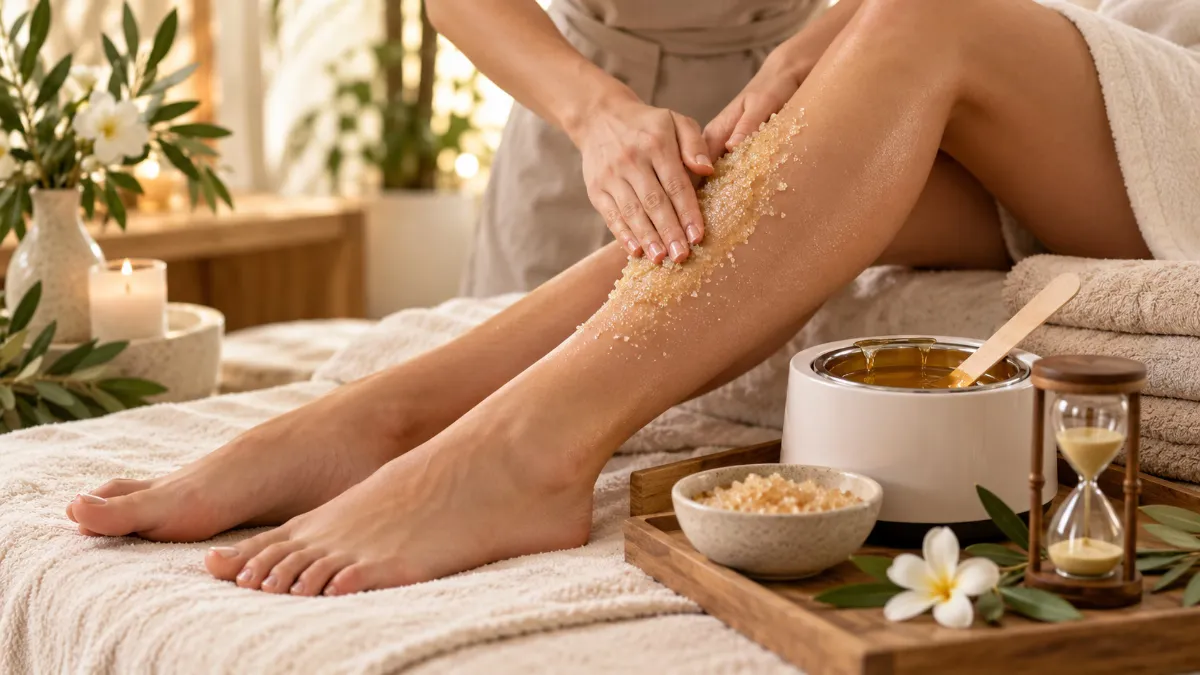
The safest choice is less about the ingredient name and more about how coarse the particles are, how the product is formulated, and how firmly you use it. A fine sugar scrub is usually easier to use gently on larger areas such as the legs and back. Avoid coarse salt, rough coffee grounds, or any scrub that feels sharp or scratchy in the day or two before waxing.
The 24 hours before your wax: what to skip
In the final day before your appointment, skip physical exfoliation: no scrubs, dry brushing, or exfoliating mitts. Also be cautious with strong acids or other products that leave your skin irritated. For facial waxing, the American Academy of Dermatology recommends avoiding retinol and prescription topical retinoids for two to five days beforehand because waxing can remove skin along with hair. If you are taking isotretinoin, do not wax during treatment or for six months after stopping it; the AAD specifically warns against waxing during that period.
How soon to exfoliate after waxing: timing by body zone
As a practical rule, wait at least 48 hours after waxing before using a physical scrub. Sensitive areas may need 48 to 72 hours or longer. The clock is only a starting point: if the skin is still red, tender, warm, itchy, or irritated, wait until it has fully settled.
Zone | Practical starting point before a gentle physical scrub |
Legs, arms, back | About 48 hours, if the skin is calm |
Bikini, underarm, face | 48 to 72 hours, or until the skin is fully calm |
Legs and arms: 48 hours is a useful starting point
For legs and arms, a gentle scrub is often reasonable around the 48-hour mark if there is no lingering redness or tenderness. Do not treat 48 hours as a deadline, though. If the skin still feels reactive, give it more time.
Bikini, underarm, and face: give sensitive skin more time
These areas are commonly more sensitive to waxing and friction, so a 48- to 72-hour pause is a safer starting point. Let the condition of the skin decide when you restart. If there is still visible redness, soreness, or stinging at 72 hours, wait another day rather than exfoliating on schedule.
Sugar or enzyme: which exfoliant works after waxing
Once the skin has fully settled, people who are prone to irritation may prefer a mild, non-abrasive exfoliant over a gritty physical scrub. Enzyme products can be an option, but they are not automatically irritation-free, so patch-test unfamiliar formulas and stop if they sting or inflame the skin.
Enzyme exfoliants: a non-abrasive option for reactive skin
Enzyme exfoliants often use papaya- or pineapple-derived enzymes to loosen dead surface cells without granules. That removes the mechanical scrubbing step, which can be helpful for bikini, underarm, and facial skin once post-wax sensitivity has passed. The key phrase is once the skin has settled: do not apply an active exfoliant to skin that is still visibly irritated.
Physical scrubs (sugar, salt, coffee): when each earns a place
Once reactivity has fully cleared, gentle physical exfoliation can return to the routine during regrowth. Fine sugar is usually the easiest physical option to control on the body. Coffee grounds and coarse salt can be much grittier, so they are better avoided on delicate or recently waxed areas. Keep pressure light and adjust frequency to your skin rather than forcing a fixed schedule; for many people, a few gentle sessions per week during regrowth is enough.
Should you combine a body scrub and waxing in one spa visit?
Ideally, no. A physical body scrub is best scheduled before waxing with a recovery gap between the two services, rather than stacking them in the same appointment. A useful default is to book the scrub about 24 to 48 hours before the wax, with around 48 hours being the more conservative option for sensitive skin. And once an area has been waxed, do not physically scrub it again in the same session.
Why sensitive zones are better split across two visits
Bikini, underarm, and facial skin can be especially reactive after hair removal, so separating the appointments avoids layering mechanical exfoliation and waxing on the same day. If you want both services, place the body scrub first and the wax on a later day, then allow the waxed area to calm fully before exfoliating again.
Your 7-day waxing prep calendar
Anura Spa's sequencing framework maps the cycle onto one week so you are not guessing:
Day 1: Physical exfoliation with a fine, gentle scrub to clear dead surface cells and free surface hairs.
Day 2: Rest. Moisturise and avoid irritating actives.
Day 3: Wax appointment, with the skin settled and intact.
Day 4 to 5: Soothe and hydrate only. No physical exfoliation on the waxed area.
Day 6 onward: If the skin is fully calm, resume gently. Use a mild non-abrasive option on delicate zones or a light sugar scrub on larger body areas, then adjust frequency to how your skin responds.
Shift the wax day to suit your booking, and move the surrounding days with it. Treat the gaps as conservative defaults rather than rigid deadlines: if your skin is still irritated, give it longer.
Reader questions on body scrub and waxing timing
Can I book a body scrub and waxing in the same visit?
It is better to separate them. Book the body scrub first, ideally about 24 to 48 hours before the wax, rather than physically exfoliating and waxing the same area in one session. Sensitive areas such as the bikini line and underarms benefit most from that recovery gap.
How many days before waxing should I use a body scrub on my legs?
One to two days before is a practical window. Around 48 hours is the conservative choice if your skin is sensitive or you are using a physical scrub. Keep the exfoliation gentle and skip it if the area is already irritated.
Is a sugar scrub or salt scrub safer to use in the week before a wax?
A fine sugar scrub is usually the gentler default, but particle size, formulation, and pressure matter more than the ingredient name alone. Avoid coarse salt or any scrub that feels sharp or abrasive close to a waxing appointment.
How soon after a Brazilian wax can I exfoliate the bikini area?
Give the area about 48 to 72 hours, then restart only if the skin is fully calm. If redness, soreness, or stinging remains at 72 hours, wait longer. When you do restart, keep the first exfoliation mild rather than jumping straight back into an aggressive scrub.
Why do I still get ingrown hairs after waxing?
Ingrown hairs can be influenced by hair type, regrowth pattern, friction, dead-cell buildup, and hair-removal technique. Exfoliation can help keep the surface clear during regrowth, but more scrubbing is not always better. Resume only after the skin has recovered, use light pressure, and stop if the area becomes inflamed.
Get the order right, and you reduce the chance of creating avoidable irritation around a wax. If you would rather have the sequence handled for you, see the body scrub and waxing service pages to plan the treatments in the right order.