Arthritis often leaves your joints painful, stiff, swollen, or difficult to move. It can also tighten the muscles around the affected area, making everyday activities such as walking, climbing stairs, opening jars, or turning your neck more challenging.
Many people wonder whether massage can help relieve these symptoms and whether it is safe for every type of arthritis. The answer depends on the type of arthritis you have, the condition of your joints, and the massage technique used.
In this guide, you'll learn how massage may help people with arthritis, what the research shows, the benefits and limitations of massage therapy, the safest massage approaches, when massage should be avoided, and how to choose a treatment that fits your needs.
Key Highlights:
Massage may provide short-term relief from arthritis pain and stiffness for some people.
It can relax tight muscles around affected joints without treating the underlying arthritis itself.
Research is mixed and differs by arthritis type; evidence is stronger for short-term symptom relief than for long-term benefit.
Gentle or moderate pressure is usually more appropriate around sensitive joints than forceful pressure.
Avoid direct massage over hot, swollen, severely painful, or actively inflamed joints.
Massage can complement arthritis care, but it does not cure arthritis or reverse joint damage.
Tell your therapist which joints are affected and whether you are having a flare before the session begins.
Does Massage Help Arthritis?
Massage may help some people with arthritis feel less pain, stiffness, or muscle tension for a short time. By relaxing the muscles and soft tissues around an affected joint, massage can make movement feel more comfortable without changing the arthritis itself.
The evidence is not the same for every type of arthritis. An NCCIH-funded randomized trial found short-term improvements in pain, stiffness, and physical function in people with knee osteoarthritis after weekly massage. For rheumatoid arthritis, the 2022 American College of Rheumatology guideline conditionally recommends massage over no massage, but notes that the certainty of evidence is very low.
Massage does not cure arthritis, rebuild cartilage, or prevent the condition from progressing. It is best treated as a complementary option alongside clinician-recommended care, regular movement or exercise, physical therapy when appropriate, and medication or other treatment when prescribed.
How Does Massage Help Arthritis Pain?
Massage mainly works on the muscles and soft tissues around a painful joint. When arthritis limits movement, nearby muscles may tighten or guard the area, which can add to stiffness and discomfort.
Comfortable massage pressure can reduce that surrounding muscle tension and help the area feel easier to move. It does not directly repair cartilage or remove the inflammation that causes many forms of arthritis.
Pressure should stay comfortable. Harder does not mean better, especially around sensitive joints. If you are unsure what level to request, use our massage pressure levels guide as a starting point, and ask the therapist to adjust during the session. Stop if massage causes sharp pain, throbbing, numbness, or increasing soreness.
What Does the Research Say About Massage for Arthritis?
Research on massage for arthritis is promising in some areas but mixed overall. Some trials report short-term improvements in pain, stiffness, function, or hand strength, while major guidelines emphasize that the evidence is limited and varies by condition. Massage should therefore be viewed as a complementary option for symptom comfort rather than a primary treatment for arthritis.
1. Massage for Knee Osteoarthritis
A randomized clinical trial funded by the National Center for Complementary and Integrative Health included 222 people with knee osteoarthritis. Participants receiving 60-minute whole-body Swedish massage once a week for eight weeks had short-term improvements in pain, stiffness, and physical function. The study also reported that longer-term benefits were less clear.
At the same time, the 2019 American College of Rheumatology/Arthritis Foundation osteoarthritis guideline conditionally recommends against massage specifically for reducing knee or hip osteoarthritis symptoms because the overall evidence was limited and at high risk of bias. The guideline also notes that some patients report symptom benefits and that massage may have other uses.
For a painful knee, a therapist can focus on the surrounding thighs, calves, and hamstrings rather than applying strong pressure directly over a swollen or very tender joint.
2. Massage for Rheumatoid and Hand Arthritis
For rheumatoid arthritis, the 2022 American College of Rheumatology guideline conditionally recommends massage over no massage, based on very low-certainty evidence for pain improvement. It also notes that technique and intensity matter and that massage is best delivered by someone experienced in working with people who have rheumatoid arthritis.
A 2026 randomized pilot study involving 30 women with early-stage rheumatoid arthritis in low disease activity or remission found that 10 hand-massage sessions improved grip strength, pinch strength, and hand function. The study did not find a significant improvement in pain threshold, and the authors called for larger and longer studies.
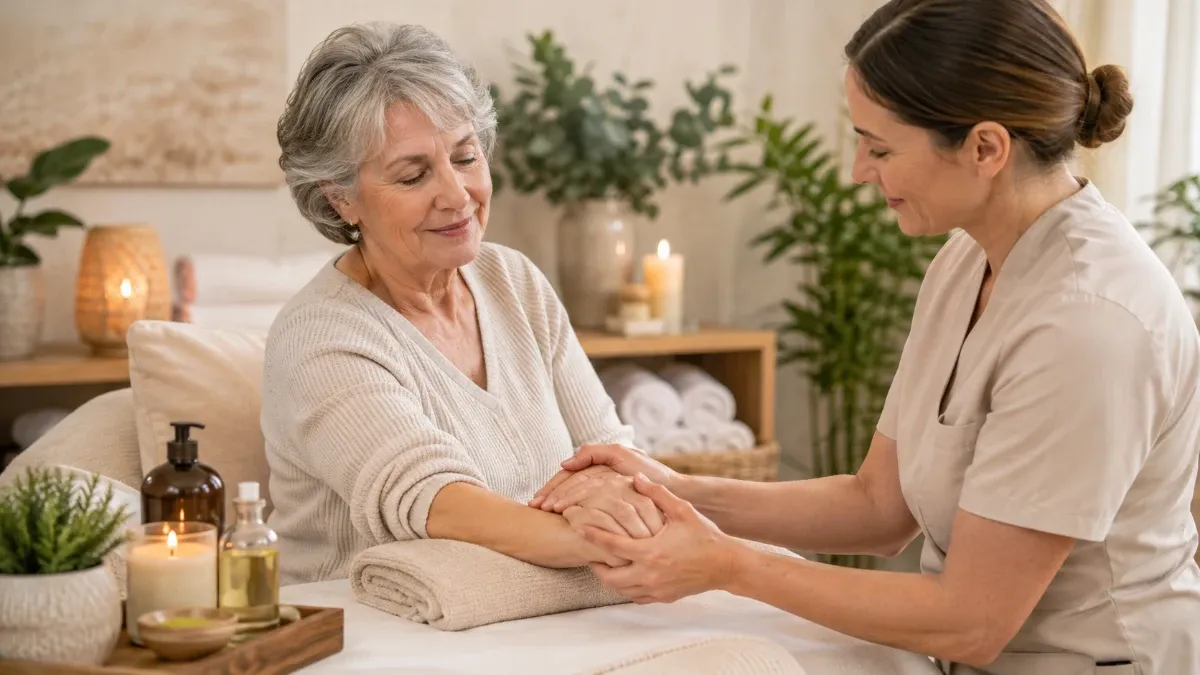
Gentle self-massage may also feel comfortable between professional sessions. Keep pressure light around swollen knuckles and avoid pulling or forcefully bending painful fingers.
What the Research Does Not Show
Research does not show that massage rebuilds cartilage, cures arthritis, or prevents joint damage. When benefits occur, they are generally related to symptoms such as pain, stiffness, muscle tension, function, or relaxation rather than the underlying disease process.
Massage should be used as part of a broader arthritis care plan alongside medical treatment, exercise or physical therapy, and other strategies recommended for your specific type of arthritis.
Does Massage Help Different Types of Arthritis?
Massage affects each type of arthritis differently. The right pressure, timing, and technique depend on whether your joints are stable, inflamed, swollen, damaged, or especially painful.
1. Osteoarthritis
Massage may reduce surrounding muscle tension and make stiff areas feel more comfortable for some people with osteoarthritis, particularly around the knees, hands, shoulders, hips, neck, and lower back.
It does not rebuild worn cartilage. Because guideline support for massage as an osteoarthritis treatment is limited, use it for comfort rather than as a replacement for exercise, medical care, or other recommended treatment.
2. Rheumatoid Arthritis
Gentle massage may be an option when rheumatoid arthritis is stable and the joints being worked on are not actively inflamed. During a flare, avoid strong pressure on joints that feel hot, swollen, tender, or severely painful.
Tell your therapist which joints are affected before the session. The therapist should adjust pressure and positioning for comfort and avoid forceful movement of painful joints.
3. Psoriatic Arthritis
Massage may help relax tight muscles around joints affected by psoriatic arthritis and may reduce the muscle tension that develops when pain changes the way you sit, stand, or walk.
Avoid massage over cracked or broken skin, open wounds, skin infections, severely irritated areas, and hot or swollen joints. The therapist should work around these areas rather than directly over them.
4. Gout
Do not massage a joint during an active gout attack. The area can be hot, red, swollen, and extremely painful, and direct pressure is unlikely to be comfortable.
Wait until the flare has settled before returning to massage, and follow the treatment plan recommended by your healthcare professional.
When Should You Avoid or Delay Massage for Arthritis?
Massage is generally low risk when performed appropriately, but vigorous massage can cause injury in people who are more vulnerable. The Arthritis Foundation and NCCIH advise extra caution when joints or tissues are inflamed, damaged, or otherwise at increased risk.
Avoid direct massage over, or seek medical advice before massage if you have:
A hot, red, swollen, or actively inflamed joint or an active gout attack.
Open wounds, a skin infection, a significant rash, or severely irritated skin in the treatment area.
Severe osteoporosis, fragile bones, or a recent fracture.
A recent joint surgery or joint replacement that has not been cleared for massage.
A bleeding disorder, low platelets, or anticoagulant medication when deep or forceful massage is being considered.
Reduced sensation, significant nerve problems, or circulation problems in the area being treated.
Pain that is unexplained, rapidly worsening, or different from your usual arthritis symptoms.
If you are unsure whether massage is appropriate for your condition, ask your healthcare professional before booking.
Which Areas of the Body Benefit From Arthritis Massage?
Massage for arthritis generally focuses on the muscles and soft tissues around the affected joints rather than pressing hard into the joints themselves. Common areas include:
Hands and fingers: Gentle strokes across the fingers, palms, wrists, and forearms may reduce surrounding muscle tension and support comfortable movement. Avoid strong pressure on swollen knuckles.
Knees: Work on the thighs, calves, and hamstrings can ease tension in the muscles that support the knee. Avoid strong pressure directly over a swollen or very painful joint.
Feet and ankles: Gentle work around the soles, arches, lower legs, and ankle-supporting muscles may feel relieving. Avoid massage during a gout attack or over wounds, swelling, infection, or numb areas.
Neck: Massage can focus on tight muscles across the neck, shoulders, and upper back. Avoid forceful twisting or heavy pressure over the spine.
Always avoid direct pressure on joints that feel hot, swollen, severely painful, or actively inflamed.
What Type of Massage Is Best for Arthritis?
Swedish Massage
Swedish massage can be a practical starting option because it typically uses long strokes, gentle kneading, and light-to-moderate pressure.
This style can relax surrounding muscles without requiring heavy pressure on sensitive joints. Pressure should still be adjusted to your symptoms and comfort.
Gentle Therapeutic Massage
Gentle therapeutic massage focuses on the muscles around affected joints while adjusting pressure, body position, and session length to your symptoms.
This approach may suit people whose stiffness, limited movement, or tenderness makes a standard full-body massage uncomfortable.
Deep Tissue Massage
Deep tissue massage may help tight surrounding muscles, but it is not a treatment for arthritis itself and is not appropriate over inflamed, fragile, or severely painful joints.
If deeper work is used, pressure should stay on suitable muscle areas rather than swollen joints, damaged tissue, or bony areas. Avoid deep tissue work during an active flare, and stop if the pressure causes sharp or increasing pain.
Self-Massage
Gentle self-massage can be used on the hands, fingers, feet, forearms, shoulders, and muscles around the knees when those areas are not actively inflamed.
Keep movements slow and pressure comfortable. Avoid forceful joint movement and stop if symptoms worsen.
Does Heat and Massage Help Arthritis?
Gentle heat before massage may make stiff muscles and joints feel more comfortable. A warm towel, warm shower, or heating pad can be used briefly before the session, provided the area is not already hot or inflamed.
Do not use heat on:
A hot and swollen joint
Broken or irritated skin
An area with reduced sensation
A fresh injury
An active inflammatory flare
Heat is generally used for stiffness and muscle tightness, while cold may be more appropriate when swelling or inflammation is active. Follow your healthcare professional's advice if you are unsure which is appropriate.
How Should You Prepare for an Arthritis Massage?
Prepare for an arthritis massage by telling your therapist about your diagnosis, painful joints, current symptoms, and any health concerns. This helps the therapist choose safer techniques and an appropriate pressure level.
Before your massage, tell your therapist:
Which type of arthritis you have.
Which joints hurt or feel unstable.
Whether you are having an active flare.
Which movements cause pain.
Whether you have had a joint replacement or recent surgery.
Whether you have osteoporosis or a history of fractures.
Whether you have nerve, sensation, bleeding, or circulation problems.
Which pressure level feels comfortable.
Ask the therapist to begin gently and speak up immediately if any movement or pressure causes pain. Choose a therapist who is willing to adapt the session to your condition rather than following a fixed routine.
Conclusion
Massage may provide short-term relief from pain, stiffness, or surrounding muscle tension for some people with arthritis, but the evidence varies by arthritis type and the technique used. It does not cure arthritis or reverse joint damage.
The safest approach is to avoid inflamed or swollen joints, use comfortable pressure, and make sure the therapist knows which joints are affected. If you are having an active flare, have significant joint damage, or are unsure whether massage is appropriate, speak with your healthcare professional first.
At Anura Spa, massage sessions can be adjusted around your comfort, symptoms, and preferred pressure level. Explore our massage therapy options in Kathmandu, or contact us on WhatsApp to discuss which style may be the most comfortable fit for your session.
Frequently Asked Questions
Does massage help rheumatoid arthritis?
Massage may help some people with rheumatoid arthritis with pain, muscle tension, or hand function, particularly when disease activity is low or stable. The 2022 ACR guideline conditionally recommends massage over no massage, but the evidence is very low certainty. Avoid forceful massage over hot, swollen, or actively inflamed joints.
Does hand massage help arthritis?
Hand massage may support comfort and function for some people. A small 2026 pilot study in early-stage rheumatoid arthritis found improvements in grip strength and hand function, but not in pain threshold. Keep pressure gentle around swollen or painful joints.
Does massage help arthritis in the fingers?
Gentle massage around the fingers, palms, wrists, and forearms may reduce surrounding muscle tension and support comfortable movement. Do not pull, force, or press hard on inflamed finger joints.
Does massage help knee arthritis?
Massage may provide short-term relief for some people with knee osteoarthritis. An NCCIH-funded trial found improvements in pain, stiffness, and function after eight weeks of weekly massage, although long-term benefits were less clear and clinical guideline support remains limited.
Does deep tissue massage help arthritis?
Deep tissue massage may help tight muscles around an affected area, but it does not treat arthritis itself. It should not be used directly over inflamed, fragile, swollen, or severely painful joints, and it is best avoided during an active flare.
Do heat and massage help arthritis?
Gentle heat may make stiff muscles and joints feel more comfortable before massage. Do not apply heat to a joint that is already hot, swollen, or actively inflamed, and avoid heat where sensation is reduced.
Does foot massage help arthritis?
Gentle foot massage may reduce muscle tension around the feet and ankles. Avoid massage during an active gout attack or over swollen, numb, infected, injured, or severely painful areas.
Does massage help neck arthritis?
Massage may relax tight muscles around the neck, shoulders, and upper back. Avoid forceful neck twisting and heavy pressure over the spine, and seek medical advice for new neurological symptoms, severe pain, or symptoms that radiate into the arm.
Is a massage gun safe for arthritis?
There is limited arthritis-specific research on massage guns. If you use one, keep the setting low and use it on surrounding muscle rather than directly on joints, bones, swollen areas, or painful tissue. People with fragile bones, bleeding risks, reduced sensation, or active inflammation should ask a healthcare professional before using one.
Can massage make arthritis worse?
Yes, symptoms can worsen if massage is too forceful, directly targets an inflamed joint, or is performed during an active flare. Massage should feel comfortable during and after the session; increasing pain is a reason to stop and reassess.
Is massage a cure for arthritis?
No. Massage may help with symptoms such as pain, stiffness, muscle tension, or relaxation, but it does not cure arthritis, rebuild cartilage, or reverse joint damage.
Ready to experience it? Book a deep tissue massage at Anura Spa in Thamel, Kathmandu.